


Carrier Fuel Surcharges Are At Record Highs in 2026: What 3PLs Must Do Before It Gets Worse

There's a cost crisis building quietly inside the shipping lanes of nearly every 3PL in the country.
It's not on the front page. It doesn't have a catchy name. But if you look at what the major carriers have been doing to their surcharge rates over the last sixty days, the numbers are staggering and for 3PLs and the brands they serve, the financial exposure is real, it's right now, and for most operations, it's not yet reflected in what they're billing their clients.
Fuel surcharges driven by geopolitical instability, specifically the ongoing conflict involving Iran and the sharp spike in global oil and jet fuel prices it has caused, have quietly climbed to levels that would have seemed extreme even a year ago. Jet fuel prices have increased roughly 95% since the start of the conflict. Every major carrier has responded.
And most 3PLs haven't caught up.
This post breaks down exactly what's happening, what it's actually costing you in dollars per shipment and dollars per month, and what DiversiFi is doing to help operators get in front of it before the margin damage compounds further.
What the Carriers Are Doing. And the Numbers Are Not Small
Let's be direct about the scope of what's happening. This isn't a minor seasonal adjustment. These are multi-year high surcharge rates across every major carrier, effective right now.
Current Carrier Fuel Surcharge Rates — April 2026

Sources: UPS fuel surcharge schedule (April 6, 2026), FedEx fuel surcharge page (April 6, 2026), USPS press release (March 25, 2026), Amazon Seller Central announcement (April 2026).
Let those numbers sit for a moment.
UPS domestic ground is now at 27%. UPS domestic air is 30.75%. UPS international air import — a critical lane for many 3PLs handling inbound goods — is sitting at 40.25%. FedEx ground is at 26.5%. And USPS, which had never charged a fuel surcharge in its entire history, just added 8% effective April 26.
Even Amazon, which built a narrative around absorbing cost increases before passing them along, has added a 3.5% fuel and logistics surcharge to its Fulfilled by Amazon sellers, effective mid-April.
Every major shipping option your 3PL uses is now more expensive than it was 90 days ago. Some by a lot.
Here's What It's Actually Costing — In Real Dollars
Surcharge percentages are abstract. Dollar impact per month is not.
The table below models the cost impact on a 3PL shipping 5,000 packages per month across the four most common carrier/service combinations. The 'Cost Before' column reflects approximate all-in per-package rates at early 2025 surcharge levels. 'Cost After' reflects current April 2026 surcharge rates.
Real-Dollar Surcharge Impact — 5,000 Packages Per Month
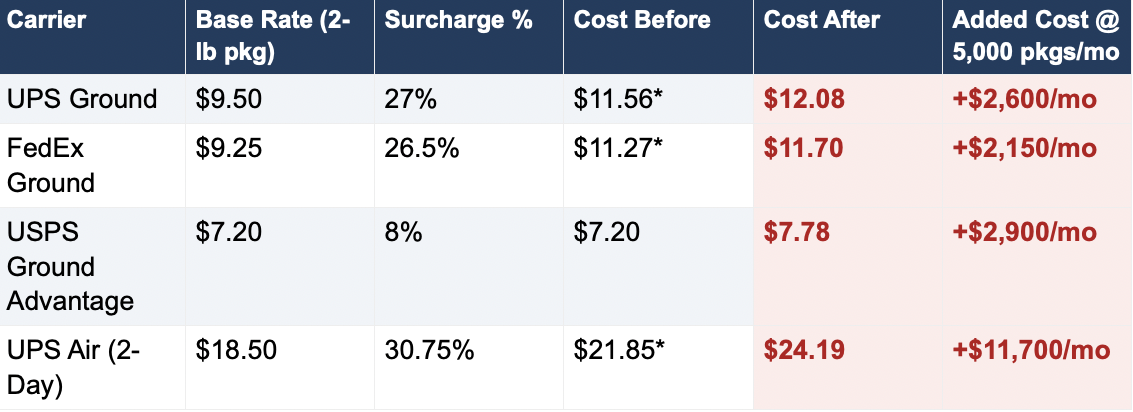
Here's the headline from that table: a 3PL running 5,000 packages per month on UPS Ground is facing roughly $2,600 in additional monthly costs just from the surcharge increase alone before any other rate changes. On UPS Air, that number balloons to nearly $11,700 per month.
Now multiply that across a portfolio of 10 or 20 client accounts, across multiple carrier types, and the picture gets serious fast.
A 3PL managing $500,000 in monthly shipping volume with a carrier mix that's 60% ground and 40% air could be looking at $40,000 to $70,000 in additional annualized surcharge costs. Most of which may not yet be reflected in client invoices.
The Hard Question: Are You Billing for This or Eating It?
This is the question every 3PL operator needs to answer right now, and most haven't sat down to do it yet.
When carrier surcharges increase, 3PLs face the same three-way decision every time: absorb the cost, pass it through to clients, or offset it through smarter carrier routing. But this time, the increases happened fast, they're large, and they're stacked on top of rate increases that were already in place.
If your billing process is built on static rate cards, markups established during contract negotiations months ago, applied through spreadsheets or manual processes, there is a very real chance that the surcharge increases of the last 60 days are not yet flowing through to your client invoices. You may be billing based on what shipping cost in Q4 2025.
The gap between what carriers are charging you and what you're charging your clients is coming out of your margin. Silently. Every shipment.
The brands you work with need to know this is happening too. Part of what makes a 3PL a true partner is bringing this kind of cost intelligence proactively — helping them understand what's hitting the shipping market, what it means for their fulfillment costs, and what options exist to offset it. The 3PLs that communicate this clearly will strengthen client relationships. The ones that don't, and then send a confusing invoice adjustment later, will damage them.
Why This Environment Is Different and Why It's Not Going Away
Carrier surcharges are not new. FedEx and UPS have adjusted fuel surcharges weekly for years. What's different right now is the scale, the speed, and the breadth of who is adding them.
The Iran conflict triggered a sharp global fuel price spike. Jet fuel has climbed roughly 95% since the fighting began. This is a massive jump. And carriers, having absorbed costs as long as they could, are now recovering aggressively.
The geopolitical situation hasn't stabilized. Which means the surcharge environment hasn't stabilized either. UPS and FedEx adjust their rates weekly. If fuel prices continue rising, surcharges continue rising with them. The April 2026 numbers in the table above are a snapshot, not a ceiling.
And there's a broader trend worth acknowledging: carriers have been moving toward more granular, dynamic cost recovery for years. The USPS surcharge wasn't just a response to the current crisis, it was a structural shift toward a model the private carriers have used for decades. That direction of travel doesn't reverse when the immediate crisis fades.
3PLs that treat this as a temporary disruption to wait out are going to find themselves repeatedly behind. The operators who are building the billing infrastructure and carrier intelligence to respond dynamically are the ones who will protect margin through whatever comes next.
What You Can Actually Control Right Now
The geopolitical situation is outside your control. Carrier pricing decisions are outside your control. But there are several things that are squarely within your control, and they're worth addressing immediately.
Know your exact surcharge exposure. Before you can make good decisions, you need to understand where you stand. Which carrier services make up what percentage of your volume? At current surcharge rates, what's the actual monthly cost increase versus 90 days ago? Until you have those numbers, you're navigating blind.
Audit your billing against current carrier costs. Pull your last 30 days of carrier invoices. Compare the surcharge rates being applied against what you're charging clients. If there's a gap, that's the margin you're currently absorbing. Quantify it.
Have proactive conversations with clients. Don't wait for clients to notice an invoice change and call you. Send a short, clear brief explaining what's happening in the carrier market, what the specific surcharges are, and how you're handling cost pass-through. That conversation, done proactively, builds trust. Done reactively, it builds disputes.
Evaluate your carrier mix actively. At current surcharge levels, the relative economics between carriers shift. USPS Ground Advantage at 8% may now be more competitive than UPS Ground at 27% for certain package profiles, even accounting for service differences. Regional carriers — OnTrac, Veho, others — may offer better economics on specific lanes. Don't assume the routing decisions you made last year still make sense today.
Make sure your billing infrastructure can keep up. If the answer to 'how quickly can you update client billing to reflect a carrier surcharge change' is 'it takes us a few weeks and some manual work,' that's the real problem. In an environment where surcharges are moving weekly, billing lag is margin loss.
DiversiFi Can Model Your Surcharge Exposure For Free
We know that quantifying this kind of exposure takes time most operators don't have. So here's what we're offering.
If you share your shipping volume and carrier mix with the DiversiFi team, we'll model out your current surcharge exposure at no cost. We'll show you:
- The exact dollar impact of current carrier surcharge rates on your monthly shipping spend
- Where the gap is between what you're being charged and what you're currently billing clients
- Which carrier lanes are most exposed and where rerouting creates the most margin protection
- What an automated billing setup looks like for your specific operation so surcharge changes are captured automatically going forward
This isn't a sales pitch dressed up as a free offer. It's a real analysis, built on your actual numbers, that gives you the clarity to make good decisions in a market that isn't slowing down.
The 3PLs that are getting in front of this surcharge environment right now are the ones who are billing accurately, communicating proactively with brands, and routing intelligently. These are the operators who will come out of this period stronger than their competitors who are still hoping it resolves itself.
DiversiFi was built for exactly this kind of environment. Dynamic costs. Thin margins. Decisions that have to be made fast and made right.
Let us show you where you stand.
The Bottom Line
Carrier fuel surcharges are at multi-year highs across every major shipping option in the market. The increases are driven by geopolitical instability that hasn't resolved. They arrived fast, they're large, and the environment could get worse before it gets better.
For 3PLs, the exposure is real and it's compounding right now. Every shipment that's being billed at last quarter's rates while being charged at today's surcharge levels is a margin loss. Multiplied across thousands of shipments and dozens of client accounts, it adds up to a number that most operators would not be comfortable with if they saw it clearly.
The good news is that this is a problem with solutions. Better visibility. Smarter carrier routing. Billing infrastructure that captures surcharge changes automatically. And a partner who can help you model the impact and get in front of it.
That's what DiversiFi does.
Reach out and let's run the numbers together.
Frequently asked questions
What is AI carrier routing and how does it work for 3PLs?
What are carrier surcharges and how do they affect 3PL margins?
What is 3PL software?
Continue learning



See AI for your 3PL In Action
Discover how our solutions can drive your success.