

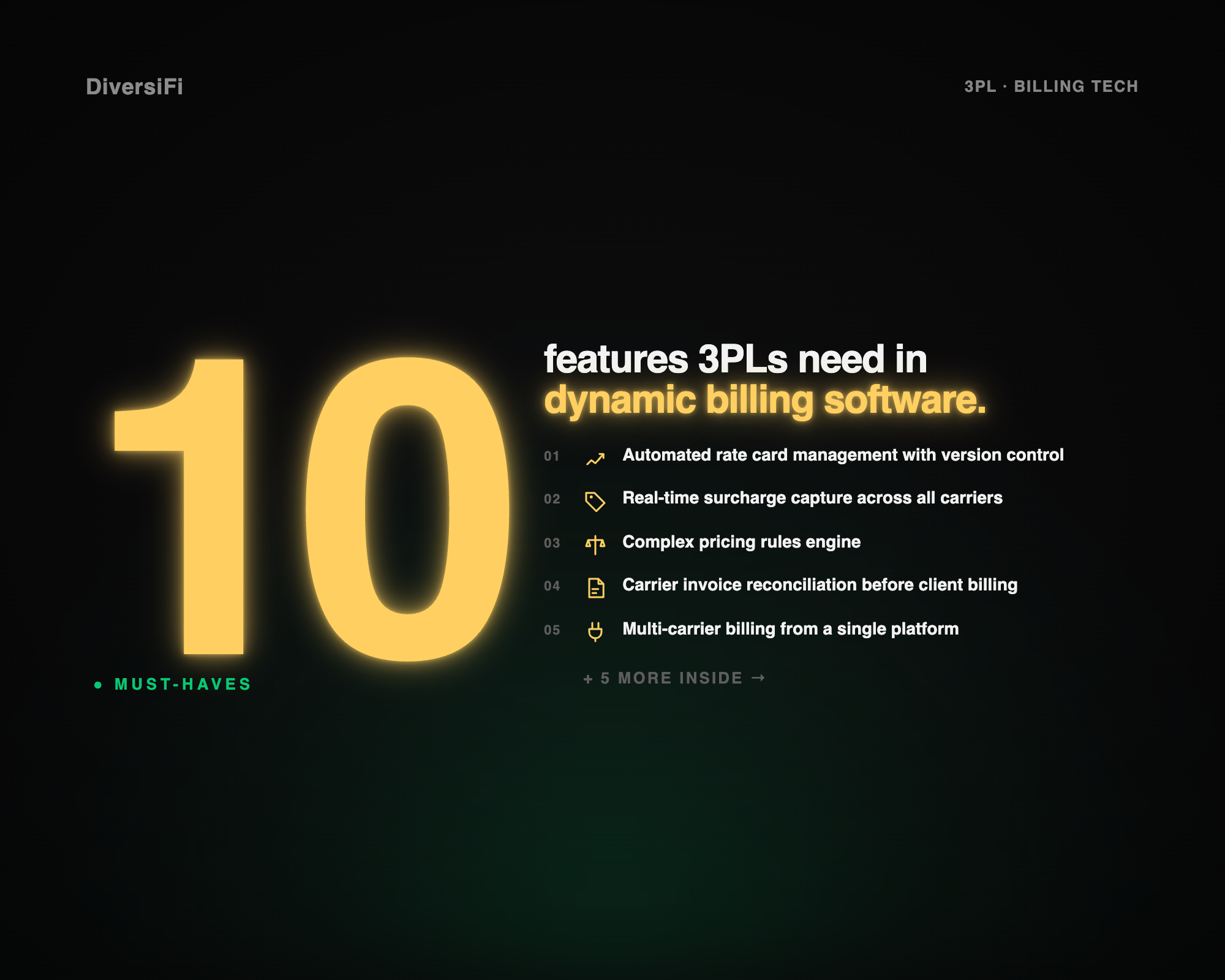
10 Features 3PLs Need in Dynamic Billing Software

If you've been running billing on spreadsheets and a prayer, you already know it's not sustainable. The question isn't really whether to upgrade , it's what to look for when you do.
There's no shortage of software vendors claiming their platform solves 3PL billing. But dynamic billing for a 3PL isn't the same as billing software for a SaaS company, a freight broker, or a generic logistics operation. You're managing complex pricing structures across multiple clients, multiple carriers, and multiple service types (all at the same time). And when surcharges change, carrier contracts update, or a client's rate card gets renegotiated, everything downstream needs to reflect that instantly.
This post is a practical checklist. Ten features that genuinely matter for 3PL billing automation, why each one earns its spot, and what to ask vendors when you're evaluating your options.
Why 3PL Billing Is Harder Than It Looks
Before jumping into the list, it's worth framing the problem. 3PL billing is complex in a way that's different from most other industries, not because the individual charges are complicated, but because of the sheer number of variables that have to be managed simultaneously.
You might have 40 clients, each with a unique rate card. You're working with five carriers, each with their own surcharge schedules that change on different cycles. Some clients are billed on weight, some on volume, some on a combination. Some have accessorial charges negotiated into their contracts; others are billed at pass-through. You have DIM weight rules that vary by carrier. Fuel surcharges that move weekly.
The right dynamic billing software doesn't just help you send invoices faster. It acts as a massive, intelligent rules engine that holds all of that complexity in one place, applying the right logic to every shipment automatically, and giving you the visibility to know what's happening across the entire operation at any moment. Think of it as a central repository for all your billing intelligence: rate cards, carrier contracts, client agreements, surcharge schedules, and pricing exceptions. All stored, versioned, and enforced in one system.
With that context, here's what to look for.
The 10 Features That Actually Matter For Dynamic Billing
1. Automated Rate Card Management with Version Control
Your rate cards are the foundation of your billing accuracy. If they're living in spreadsheets or TMS configuration files that get updated manually, they're wrong the moment something changes and in the current carrier environment, something is always changing. Look for a platform that stores rate cards as version-controlled records, applies the correct version automatically to each shipment based on the billing date, and makes it easy to update pricing when contracts change without disrupting historical data. Ask vendors: Can I see an audit trail showing which rate card version was applied to a specific shipment, and when it was last updated?
2. Real-Time Surcharge Capture Across All Carriers
Surcharges are where most billing leakage happens, and the problem is getting worse as carrier surcharge schedules have climbed throughout 2025 and 2026. You need a system that maintains current surcharge tables for every carrier you use — fuel, residential, DIM weight, delivery area, address correction, and any accessorials in your carrier contracts and applies them automatically at the shipment level. This isn't a nice-to-have. It's the difference between billing what you're owed and quietly absorbing costs on every affected shipment. Ask vendors: How does the system handle surcharge schedule updates? Is it automatic, or does my team need to update rates manually?
3. Complex Pricing Rules Engine
Every 3PL has pricing logic that doesn't fit neatly into a standard template. Minimums per shipment. Tiered rates based on volume thresholds. Client-specific accessorial agreements. Markup structures that vary by service type. Special handling fees that only apply to certain SKU categories. Good dynamic billing software isn't just a rate calculator, it's a rules engine that can encode all of your pricing logic and apply it consistently, without requiring a human to remember every exception. The system should handle your most complicated client contract the same way it handles your simplest one. Ask vendors: Can you show me how you'd configure a client with tiered pricing, a per-shipment minimum, and a negotiated residential surcharge cap?
4. Carrier Invoice Reconciliation Before Client Billing
One of the most common sources of billing disputes is invoicing clients before verifying what the carrier actually charged. When your client billing is based on estimated charges rather than reconciled actuals, you're exposed to two bad outcomes: you under bill (absorbing the difference) or you over bill (creating a dispute). Strong dynamic billing software closes this gap by matching carrier invoices against shipment records before generating client invoices. Discrepancies surface as exceptions for review rather than as errors that land in your client's inbox. Ask vendors: What is the workflow when a carrier invoice doesn't match the expected charge? How are exceptions flagged and resolved?
5. Multi-Carrier Billing From a Single Platform
If you're managing UPS, FedEx, USPS, regional carriers, and LTL providers through separate billing processes, you're creating unnecessary complexity and multiplying your error surface. The right platform handles all of your carriers in one place with carrier-specific rate logic, surcharge schedules, and invoice formats all managed centrally. This also matters for reporting: when billing data is unified across carriers, you can see your true cost-to-bill relationship across the entire operation, not just for individual carrier lanes. Ask vendors: Which carriers are natively supported? How are new carriers or contract updates added to the system?
6. TMS Integration Without Manual Data Transfer
Your billing system needs to talk to your TMS automatically, reliably, and without your team serving as the middleman. If billing data has to be exported from your TMS and manually imported into your billing platform, you have a gap where errors can enter and timeliness can slip. Look for native integrations or robust API connections that pull shipment data directly from your TMS into the billing workflow. The goal is a process where a shipment closes in your TMS and the billing data flows downstream without anyone touching it. Ask vendors: What TMS platforms do you integrate with natively? Is data transferred in real time or in batches?
7. Client-Facing Invoice Transparency
Billing disputes often aren't about the amount; they're about the explanation. When a client can't understand why they're being charged a specific amount for a specific shipment, they dispute it even if the charge is correct. Good billing software generates invoices that tell the full story: service type, weight, applied rate, surcharge breakdown, and any accessorials, all at the line-item level. Clients who can audit their own invoices without having to call you are clients who trust your billing process. Ask vendors: Can I see an example of the invoice output? Is the surcharge and rate card breakdown visible to the client at the line-item level?
8. Data Privacy and Client Data Separation
This one doesn't get talked about enough, but it matters, especially as 3PLs grow their client base and handle more sensitive shipment data. Your billing platform is a repository for client pricing, volumes, shipping patterns, and contract terms. That data needs to be protected. Look for a platform with role-based access controls so team members only see the clients and data relevant to their work. Client data should be logically separated so no configuration error or user mistake can expose one client's rate structure or billing history to another. Understand where your data is stored, how it's encrypted, and who at the vendor has access to it. Ask vendors: How is client data isolated within the platform? What access controls exist, and who at your organization can view our clients' billing data?
9. Reporting and Margin Visibility by Client, Carrier, and Lane
Billing automation should do more than generate accurate invoices. It should give you insight into where your margin is healthy and where it isn't. The best platforms surface margin data at the client level, the carrier level, and the lane level, so you can see which accounts are profitable and which are eroding margin through surcharge exposure or underpriced contracts. This data feeds better bidding decisions, better carrier negotiations, and better client conversations at renewal time. Ask vendors: What reporting is available out of the box? Can I see margin by client and by carrier lane without building a custom report?
10. Scalability Across Client and Shipment Volume Growth
The platform that works for 20 clients and 3,000 shipments a month needs to work just as well (and just as accurately) when you're at 60 clients and 15,000 shipments a month. This is a technical and architectural question, not just a features question. Ask about performance under volume, how rate card complexity scales as you add clients with different pricing structures, and whether the pricing model means your billing costs grow proportionally with your business. Ask vendors: What is your largest 3PL customer by shipment volume? How does the platform perform during peak volume periods, and how is pricing structured as we scale?
Quick-Reference Checklist
Use this in your vendor evaluation conversations:

What This All Adds Up To
The right 3PL dynamic billing software isn't just a faster way to send invoices. It's the operational foundation that connects your carrier costs, your client pricing, your margin performance, and your billing accuracy into one coherent system. It's a single repository where all your billing intelligence lives and a rules engine that enforces it automatically across every shipment you move.
When that foundation is solid, everything downstream gets better. Fewer disputes. Faster billing cycles. More accurate bids. Better carrier negotiations. Clients who trust what they receive. And margin that shows up where it belongs — on your bottom line.
If you're evaluating platforms and want to understand how DiversiFi's AI Dynamic Billing addresses each of these features in practice, we're happy to walk through it. We also offer free cost modeling to show where your current billing process is leaving margin on the table before you make any decision.
Start there. The numbers usually make the conversation pretty straightforward.
Frequently asked questions
What is margin leakage in 3PL billing?
What are carrier surcharges and how do they affect 3PL margins?
How does AI dynamic billing work?
Continue learning



See AI for your 3PL In Action
Discover how our solutions can drive your success.