


Rate Card Management for 3PL Billing: The Definitive Guide for 202

Ask most 3PL billing leaders where their biggest operational headache lives, and they will eventually land on the same answer: rate cards. Not the rates themselves. The management of them. Keeping them current. Applying the right version to the right shipment. Making sure a client-specific exception does not get applied to the wrong account. Catching the gap between what the carrier charged and what the rate card says they should have charged.
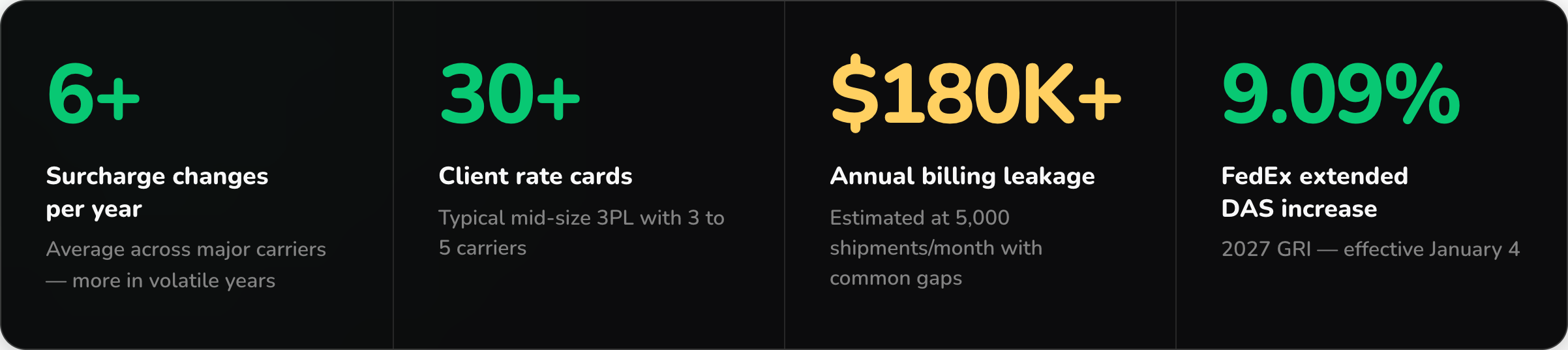
In a stable carrier environment, that management overhead is significant. In 2026, with the FedEx 2027 GRI effective January 4, UPS surcharges running at 22.25% on ground, and most growing 3PLs managing five or more carriers simultaneously, it is the difference between billing that protects margin and billing that quietly gives it away.
This guide covers what rate card management in 3PL billing actually involves, where manual processes break down, and how 3PL freight billing automation changes the equation in ways that compound over time.
What Rate Cards Actually Are in a 3PL Context
A rate card is the pricing agreement between a 3PL and a specific client, encoded as a set of rules that define what gets charged for every type of service, under every applicable condition. That sounds simple. In practice, a single client's rate card might include:
- A base per-shipment rate that varies by carrier, service type, and zone
- Weight-based pricing with different tiers above and below a defined threshold
- A per-shipment minimum charge that applies when the calculated rate falls below it
- Surcharge pass-through rules that define how fuel, residential, DIM weight, and delivery area surcharges get billed
- Service-specific accessorial agreements — for example, a residential surcharge waiver on a specific economy service
- Markup structures that differ by service type or carrier
- Volume-based discounts that trigger above monthly shipment thresholds
- Storage and handling fees for warehouse-activity billing
A 3PL with 30 clients across 5 carriers does not have one rate card. It has dozens of variations, each with its own logic, its own exceptions, and its own effective date. Managing all of that manually is where billing errors originate.
Where Manual Rate Card Management Breaks Down
There are four specific failure modes in manual rate card management. All of them are predictable. All of them are preventable with the right billing infrastructure.
Failure mode 1: Stale rates after a GRI or surcharge update
Carrier rates change on a schedule that does not accommodate billing team bandwidth. GRIs take effect annually, usually in January. Fuel surcharges update weekly or monthly based on published diesel price indices. Accessorial fees get revised quarterly and sometimes mid-cycle. Regional and alternative carriers update their schedules independently.
When a rate changes, the billing team has to find the announcement, interpret the relevant changes for each client's rate structure, update each affected rate card, and validate the output before the next billing cycle. That process takes time. During that window, every shipment billed is either undercharging (absorbing the difference) or operating on approximations that will need to be corrected later.
The 2027 FedEx GRI is a useful current example. The headline is 5.9%, but five of seven services land above that average. Extended Delivery Area Surcharges move 8 to 9%. Light package weight breaks move 6.49%. A billing team applying a flat 5.9% adjustment to every client rate card after January 4 is undercharging on most of the volume that matters.
Failure mode 2: Version confusion when a rate card is updated mid-contract
Rate cards get updated for all kinds of reasons. A client renegotiates their terms mid-year. A carrier contract changes the underlying cost structure. A new service gets added to the mix. In a manual environment, updating a rate card in a spreadsheet means the previous version is either overwritten or saved in a new file with a date in the name.
When a client disputes a charge from three months ago, the question is simple: which rate applied to that shipment on that date? In a spreadsheet environment, answering that question requires finding the right version of the right file and verifying it has not been edited since. In an environment without version control, that audit is either time-consuming or impossible.
The downstream effect is not just the dispute itself. It is the credibility damage that comes from being unable to answer a billing question clearly and quickly. Clients who cannot trust that their invoices are correct start auditing everything, which creates an ongoing administrative burden that compounds with every billing cycle.
Failure mode 3: Inconsistent application of client-specific exceptions
Every 3PL has clients whose rate structures include exceptions that are not standard. A negotiated waiver on residential surcharges for a specific carrier. A capped DIM weight divisor. An agreed markup ceiling on certain service types. These exceptions exist because they were negotiated, and they are real obligations.
In a manual billing environment, applying those exceptions correctly requires whoever is building the invoice to remember them, look them up, or catch them during review. At low volumes with a small client base, that works. At scale, with 30 clients across multiple carriers and billing cycles running on compressed timelines, exceptions get missed. The client gets charged for something they should not have been charged for. A dispute follows. The credit gets issued. The relationship takes a hit.
Failure mode 4: The carrier-to-client rate gap
The most structurally dangerous failure mode in rate card management is the gap between what a carrier actually charges and what the rate card says they should charge. When carrier costs move and rate cards do not update in sync, 3PLs absorb the difference on every shipment in the gap.
This is not a billing error in the traditional sense. The invoice is technically correct against the rate card. The rate card is just wrong relative to the current carrier cost environment. The margin erosion is invisible until someone pulls a detailed account analysis and notices that profitability on certain lanes or service types has declined without any corresponding change in volume or service mix.
In the current carrier environment, this gap has never been more consequential. Fuel surcharges on UPS ground are at 22.25%, up from roughly 16% two years ago. FedEx Extended DAS is moving to $9.60 in January, up 9.09% from the current rate. A rate card built in Q2 2024 and not updated since is generating billing that reflects a carrier cost environment that no longer exists.
What Automated Rate Card Management Changes
Automated rate card management in a 3PL freight billing platform does not just speed up the manual process. It changes the architecture of how rate logic is stored, updated, and applied.
Rate cards become version-controlled records
In an automated billing system, each client's rate card exists as a version-controlled record inside the platform. Every change creates a new version with an effective date. Every shipment is matched to the rate card version that was active on the date it processed. No overwriting. No file-with-a-date-in-the-name. A full audit trail that answers any billing question by date, by shipment, by rate version.
When a client disputes a charge from two months ago, the answer takes seconds. The platform shows the rate card version in effect on that date, the specific rates applied to that shipment, and the calculation that produced the charge. Disputes that used to take hours to investigate take minutes. And the credibility that comes from being able to answer clearly and immediately has its own retention value.
Carrier rate updates propagate automatically
When FedEx publishes its 2027 GRI, an automated billing system updates the carrier rate schedule from the effective date. Not the headline percentage applied uniformly. The actual new rates by service, weight break, zone, and surcharge type. Every client rate card that references FedEx rates automatically reflects the new carrier cost input from January 4. Every surcharge rule that passes through carrier surcharges at current published rates updates without anyone touching a spreadsheet.
The billing team does not spend the first two weeks of January catching up on rate updates. They spend them on the exception review and client communication that actually requires human judgment.
Exceptions are encoded, not remembered
Client-specific exceptions live inside the rate card record in the platform, not in someone's institutional knowledge. A residential surcharge waiver on a specific service for a specific client is configured once and applied automatically to every qualifying shipment. A tiered rate that kicks in above a monthly shipment threshold applies correctly whether the billing team is working on one account or twenty simultaneously.
The only way an exception gets missed is if it was never configured, not because someone forgot to apply it on a specific invoice. That is a fundamentally more auditable and more scalable approach to managing pricing complexity.
Carrier reconciliation happens before billing, not after
The most important structural change automated billing makes to the rate card management workflow is moving carrier invoice reconciliation before client billing. In a manual environment, rate cards and carrier invoices are effectively parallel data sources that get reconciled after the client invoice is already out the door.
In an automated system, carrier invoices are matched against shipment records and validated against the rate schedule before any client invoice generates. When the carrier charged $4.50 for a residential delivery and the rate card passes through residential at $6.00, the match confirms the calculation is correct. When the carrier charged an additional handling fee that was not anticipated, it surfaces as an exception for review. The client invoice reflects validated actuals, not estimates.
This is the mechanism that closes the carrier-to-client rate gap. When reconciliation is pre-billing, every gap either gets corrected before the invoice goes out or surfaces as a flagged exception that requires a decision. The silent margin erosion that comes from stale rate cards billing against inflated carrier costs gets caught at the reconciliation layer rather than discovered in a quarterly margin review.
Rate Card Management in the Current Carrier Environment
The 2026 carrier environment is the most demanding rate card management environment most 3PLs have operated in. Here is why that matters for how you evaluate and prioritize billing automation.
Multiple GRIs and surcharge updates per year
Carriers have been updating surcharge schedules more frequently than they did before 2022. Fuel surcharges that used to be a quarterly adjustment are now monthly or weekly on some carrier programs. The FedEx 2027 GRI brings not just a base rate adjustment but changes to weight break pricing, zone uniformity, minimum charge levels, and accessorial fee structures simultaneously. Each of those is a separate update requirement in a rate card management system.
For a 3PL managing UPS, FedEx, USPS, and two regional carriers, the number of rate schedule updates that need to be reflected in billing across a calendar year is not trivial. In a manual environment, each update is a project. In an automated environment, it is a scheduled synchronization.
Expanding carrier mix multiplies complexity
The Tusk 2026 Alternative Carrier Benchmark Report showed 92% of shippers already managing two or more carriers and 68% planning to expand alternative carrier usage in the next two years. For 3PLs, that trend means more carriers in the routing mix and more carrier rate schedules to track.
Every carrier added to the mix adds a rate card dimension. Different zone definitions. Different surcharge structures. Different invoice formats. Different update cadences. In a manual rate card management environment, the complexity grows linearly with each carrier. In an automated environment, it is a configuration addition that the billing rules engine handles consistently.
The GRI timing problem
Most 3PL billing teams discover the practical challenge of GRI season not when the announcement is made, but when the first billing cycle after the effective date closes and the margin analysis shows the gap. By then, the undercharging has already happened. The question is how many cycles it will take to fully update all affected rate cards and how much was absorbed in the interim.
Automated billing platforms with live carrier rate connections do not have a GRI timing problem. The update applies from the effective date, not from when the billing team gets around to it.
Building a Rate Card Management System That Scales
For 3PL billing and operations leaders who are building or evaluating billing infrastructure, here is the architecture that makes rate card management scalable.
Version control is the foundation
Any rate card management system worth evaluating has version control built in. Not just a changelog, but a system where every rate card change is timestamped, every shipment is matched to the version in effect on its processing date, and every billing question can be answered by pulling the audit trail for that shipment.
Without this, billing disputes are unnecessarily labor-intensive and the risk of a credibility-damaging error compounds with every rate update.
Carrier rate data must be live, not manual
The rate card management system needs to connect to carrier rate data directly, not rely on a human to translate a PDF announcement into a spreadsheet update. This means API connections to carrier rate systems or structured data feeds that update on the carrier's published schedule, not on yours.
For surcharges specifically, this means the system maintains current published rates by carrier, by service type, by zone, and by applicable date. When FedEx publishes an updated fuel surcharge for a specific week, the system applies it to shipments billed in that week. When a GRI takes effect, the system applies the new base rates, weight break adjustments, minimum charges, and accessorial changes as a coordinated update, not a series of manual edits.
Client-specific logic needs a rules engine, not a spreadsheet
The pricing exceptions, minimum charges, tiered rate structures, and client-specific agreements in a typical 3PL's client base are too complex and too numerous to manage reliably in a spreadsheet. They need to be encoded in a rules engine that evaluates each shipment against the applicable conditions and applies the correct logic automatically.
The rules engine needs to handle the cases that are easy to miss manually: what happens when a client hits a volume tier mid-month and the tier applies retroactively, what the correct minimum charge is for a lightweight shipment on a specific carrier and service combination, how an accessorial override interacts with a pass-through surcharge on the same shipment. These are deterministic questions with correct answers. A rules engine gets them right every time. A manual process gets them right most of the time.
Reconciliation must be pre-billing, not post-billing
The architecture of when reconciliation happens is more consequential than any other single design decision in a 3PL billing system. Post-billing reconciliation means client invoices go out based on estimated charges and corrections happen afterward. Pre-billing reconciliation means client invoices go out based on validated actuals and disputes are prevented rather than resolved.
Pre-billing reconciliation requires carrier invoice ingestion before the billing cycle closes, automated matching against shipment records, and a clear exception workflow for discrepancies. It is more sophisticated than post-billing reconciliation. It is also the architecture that makes billing accuracy a structural property of the system rather than a function of how carefully the billing team reviewed the output.
How DiversiFi Handles Rate Card Management
DiversiFi AI Dynamic Billing was built around the rate card management problem specifically because it is where most 3PL billing leakage originates. The platform addresses each of the structural failure modes covered in this guide.
Rate cards in DiversiFi are version-controlled records. Every change is timestamped and every shipment is matched to the version active on its processing date. When a client disputes a charge, the audit trail is available in the platform immediately.
Carrier rate updates propagate automatically. When the FedEx 2027 GRI takes effect on January 4, the platform applies the correct new rates across all service types, weight breaks, zones, and surcharge categories from that date. Clients billing on pass-through surcharge structures get the correct published rate for the applicable billing period without anyone manually updating a rate schedule.
The AI rules builder, powered by Owlfred, lets billing teams encode complex pricing logic in plain language. Client-specific exceptions, tiered rate structures, minimum charges, and accessorial overrides are configured once and applied consistently to every shipment. The rules engine handles the edge cases that manual processes miss.
Carrier invoice reconciliation happens before client billing. Carrier invoices are ingested, matched against shipment records, and validated against the rate schedule. Discrepancies surface as exceptions for review. The client invoice generates from validated actuals.
The result is a billing process where rate card management is a configuration problem, not a recurring operational project. The billing team's attention goes to the decisions that require human judgment: the exceptions, the client conversations, the strategic adjustments. Not to keeping rate tables current.
If you want to model out what that leakage looks like for your specific shipment profile and carrier mix before making any platform decision, DiversiFi offers free cost modeling. We map your current billing process against current carrier rates and show you exactly where the gap is.
Rate card management is not glamorous. But it is where the margin lives.
Frequently asked questions
How does 3PL billing software handle GRI updates?
How does rate card automation work?
What causes freight billing errors in 3PLs?
Continue learning



See AI for your 3PL In Action
Discover how our solutions can drive your success.