


AI Dynamic Billing for 3PLs in 2026

If you are running a 3PL and your billing process still involves spreadsheets, manual carrier invoice lookups, and rate cards that get updated whenever someone remembers to do it, you are not just running an inefficient operation. You are leaving money on the table every single billing cycle.
The 3PL billing problem is not new. What is new in 2026 is the environment around it. The FedEx 2027 GRI just landed, effective January 4, with surcharge increases running well above the 5.9% headline on many service types. UPS is expected to follow. Fuel surcharges have reset upward after a 13.8% diesel spike this summer. The carrier cost environment is moving faster than any manual billing process can track.
AI dynamic billing software for 3PLs was built for exactly this moment. Not as a future-looking technology investment, but as an operational necessity for any 3PL trying to protect margin in a carrier cost environment that does not slow down between billing cycles.
This post covers what dynamic billing actually does, why the 2026 environment makes it more urgent than it has ever been, and what to look for when you are evaluating logistics billing platforms.
The Manual Billing Problem Has a Dollar Amount
Most 3PL operators know their billing process is imperfect. What they underestimate is the compounding cost of running it that way at scale.
Every missed surcharge is a dollar absorbed. Every stale rate card is margin given away. Every carrier invoice that does not get reconciled before the client bill goes out is exposure to a dispute that costs more to resolve than the original error. These are not rare events. They are the predictable output of a billing process built on manual inputs in a carrier environment that changes constantly.
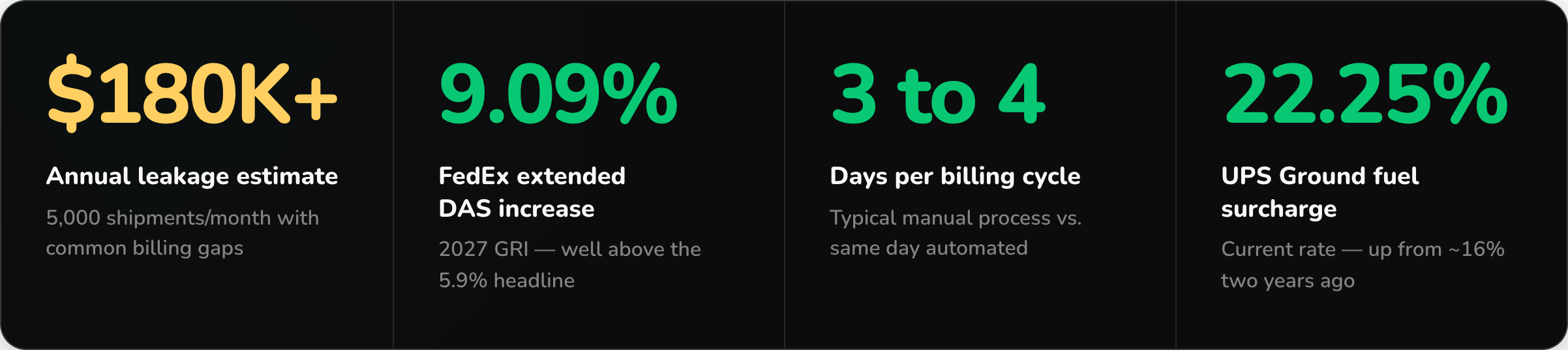
The math behind that leakage number is not theoretical. A 3PL processing 5,000 shipments per month with common billing inefficiencies, missed residential fees, fuel surcharges billed at stale rates, DIM weight errors, and unreconciled carrier adjustments, can conservatively lose $150,000 to $180,000 per year in unbilled charges. That is not recoverable after the fact. Once a billing cycle closes, those dollars are gone.
In a business running at 3 to 5% net margins, recovering $180,000 in billing accuracy is the equivalent of generating $3.6 million to $6 million in additional revenue. The math on billing automation is not close.
What AI Dynamic Billing Software Actually Does
The term dynamic billing gets used loosely. Before evaluating any platform, it is worth being specific about what genuine AI-powered dynamic billing software does for a 3PL.
It is not a faster invoicing tool. It is not a better-formatted spreadsheet. It is a connected system that changes where intelligence lives in your billing process, moving it from individual knowledge and manual effort into a rules engine that runs consistently at scale.
Automated Rate Card Management
Every client in a 3PL operation has a rate card. In a manual environment, rate cards live in spreadsheets or TMS configuration files that get updated inconsistently. When FedEx moves its Extended Delivery Area Surcharge from $8.80 to $9.60 effective January 4, the rate card has to be manually updated before that date, or every shipment billed on or after that date is wrong.
AI dynamic billing software maintains version-controlled rate cards for every client and every carrier. Updates propagate automatically when carrier rate schedules change. The correct rate is applied to the correct shipment based on the billing date, without anyone manually cross-referencing a carrier announcement against a spreadsheet. And when a client questions a charge, the audit trail shows exactly which rate card version applied on exactly which date.
Real-Time Surcharge Capture Across All Carriers
Surcharges are where most billing leakage happens, and the problem compounds with every carrier you manage. Each carrier maintains its own surcharge schedules for fuel, residential delivery, dimensional weight, delivery area, address correction, and additional handling. These schedules change on different cadences. Some update weekly. Some update with GRIs. Some update mid-cycle based on fuel index triggers.
In a manual environment, keeping current surcharge rates for three or four carriers simultaneously is a genuine operational challenge. In an automated environment, it is a configuration problem that the system handles. Every surcharge, for every carrier, applied to every shipment based on actual service characteristics, automatically.
In the current carrier environment, this is not a convenience feature. It is the difference between billing what you are owed and absorbing costs on every affected shipment. The FedEx 2027 GRI alone moved Additional Handling to a uniform 7.1% to 7.6% and Extended DAS to 9.09%. Those are not numbers a quarterly rate card review catches accurately.
Multi-Carrier Invoice Reconciliation Before Billing
The most significant structural change AI dynamic billing makes to a 3PL's workflow is moving carrier reconciliation before client billing rather than after. In a manual environment, client invoices go out based on estimated charges, and carrier invoices get reconciled afterward. When they do not match, you have two bad options: absorb the difference or go back to the client with a correction.
In an automated system, carrier invoices are matched against shipment records first. Discrepancies surface as exceptions for human review. The client invoice is generated from validated actuals, not estimates. This eliminates the category of billing error that creates disputes and the category of billing gap that creates invisible margin erosion.
For 3PLs managing UPS, FedEx, USPS, regional carriers, and alternative carriers simultaneously, this is not a minor workflow improvement. It is the foundation of a billing process that stays accurate as the carrier mix changes.
TMS Integration Without Manual Data Transfer
A billing platform that requires your team to export data from the TMS and import it into the billing system is not automating your process. It is relocating the manual step. Genuine TMS integration means shipment data flows from your TMS into the billing workflow automatically, in real time, without a human serving as the data handoff layer.
When a shipment closes in your TMS, the billing data moves downstream. When the carrier invoice arrives and matches, the client invoice generates from the validated output. The human involvement in routine billing shifts to exception review, which is where it belongs.
A Rules Engine That Holds All the Complexity
Every 3PL has pricing logic that does not fit a standard template. Per-shipment minimums. Tiered rates based on volume thresholds. Client-specific accessorial agreements. Markup structures that vary by service type. Weight or zone-based pricing exceptions that were negotiated individually and exist nowhere but a contract signed two years ago.
A dynamic billing rules engine encodes all of that complexity and applies it consistently to every shipment, without requiring anyone to remember every exception. The system handles your most complex client contract the same way it handles your simplest one, and it does so without errors introduced by manual lookup.
Why 2026 Is the Year This Becomes Urgent
Billing automation has been a good idea for several years. What changed in 2026 is the cost of not having it.
The carrier cost environment has reset at a level that makes billing accuracy a margin protection issue, not just an efficiency issue. Fuel surcharges have run at multi-year highs all year. FedEx just published its fourth consecutive GRI at 5.9%, but with structural changes that mean most 3PLs will see effective increases well above that on their actual shipment mix. UPS is expected to follow within weeks. And the 2027 surcharge environment on residential and extended delivery area shipments is moving faster than the base rate.
Every one of those changes requires a corresponding update in a billing system to be captured correctly. In a manual environment, each update is a project. The billing team has to find the announcement, cross-reference it against each client's rate structure, update each rate card, and validate the output before the next billing cycle. That process is running on a timeline that does not match how frequently carriers are changing their pricing.
In an automated environment, carrier rate updates propagate through the system. The billing team's attention goes to the exceptions and the relationships, not to the mechanics of keeping rate tables current.
The Multi-Carrier Billing Problem Is Getting Harder
Three years ago, most 3PLs managed two or three carriers. Today, the Tusk 2026 Alternative Carrier Benchmark Report shows 92% of shippers already using two or more carriers, and 68% planning to increase their alternative carrier usage in the next two years. The carrier mix is expanding, not contracting.
Every carrier added to a 3PL's routing mix is another surcharge schedule to track, another invoice format to reconcile, another rate card to maintain, another zone definition to apply correctly. In a manual billing environment, that complexity grows linearly with every carrier. In a connected billing platform, it is a configuration addition.
The 3PLs that are well-positioned for the alternative carrier shift are the ones whose billing infrastructure can absorb a new carrier without creating a billing project. When a shipper asks whether you can route through a regional carrier they want to test, the answer should not be limited by whether your billing team can manage the additional reconciliation overhead.
What to Look for When Evaluating Logistics Billing Platforms
Not all billing software is built for the complexity of a growing multi-carrier 3PL operation. Generic invoicing tools and basic TMS billing modules handle simple rate calculations. They do not handle the pricing logic, carrier reconciliation, surcharge capture, and audit trail requirements that come with managing multiple clients across multiple carriers at scale.
When evaluating dynamic billing software for 3PLs, these are the questions that separate platforms built for this environment from those that will require manual workarounds within the first quarter of use.
.png)
The answers to those questions will tell you whether a platform is genuinely built for multi-carrier 3PL billing or whether it is a general-purpose invoicing tool dressed up with logistics terminology.
How DiversiFi AI Dynamic Billing Works
DiversiFi built AI Dynamic Billing specifically for growing 3PL operators managing complex, multi-carrier billing environments. The platform is built around the problems that show up at scale, not the ones that show up when you are managing two clients and one carrier.
Everything Flows From a Single Connected System
AI Dynamic Billing connects to your TMS so shipment data flows automatically rather than through manual export. Carrier invoices are ingested across all carriers in your mix and matched against shipment records before any client invoice generates. Exceptions surface for human review. Validated actuals drive the output.
Rate cards are version-controlled inside the platform and linked to current carrier data. When FedEx publishes its 2027 GRI effective January 4, the platform applies the correct rates from that date forward without your billing team manually updating a spreadsheet. Historical shipments bill at the rate that was current when they moved. Future shipments bill at the rate that is current when they move.
Surcharges Are Captured at the Shipment Level
Every surcharge on every carrier, applied based on the actual service characteristics of each shipment. Residential flag, DIM weight, delivery area designation, fuel surcharge for the applicable billing week, accessorial triggers for additional handling or packaging. Nothing falls through because someone forgot to check the accessorial schedule or because the surcharge rate changed between the contract signature and the shipment date.
This is the billing layer that protects margin on the shipments that matter most in the current carrier environment. Extended residential surcharges. Additional handling on packages that trigger weight, dimension, or packaging flags. DAS charges on rural lanes where alternative carriers have less coverage. All of it captured automatically, all of it billable to the correct client at the correct rate.
Owlfred Builds Rules From Plain English
DiversiFi's AI assistant Owlfred sits in the billing rules builder so your team can define pricing logic in plain language rather than code. Describe the rule you want to apply, the condition that triggers it, and the outcome it produces. The platform translates it into the rules engine and lets you preview it against a real billing period before it touches a live invoice.
This matters for growing 3PLs specifically because your pricing logic gets more complex as you add clients, not less. The rules engine grows with you without requiring developer resources to maintain it.
Margin Visibility That Feeds Every Other Decision
When billing data is organized at the account level, the carrier level, and the lane level, it becomes more than an invoicing output. It becomes the data foundation for better bidding, better carrier negotiations, and better renewal conversations.
Which accounts are running at healthy margins and which have drifted as carrier costs moved? Which lanes are generating the most surcharge exposure? Which clients are approaching the volume thresholds where their rate structure should be renegotiated? All of that visibility lives in the billing data when the billing system is capturing it correctly.
DiversiFi's AI Dynamic Billing feeds that data directly into Bid Boost and AI Carrier Routing, so the same information that makes your invoices accurate makes your bids more precise and your routing decisions smarter. The platform gets more valuable over time as the data compounds.
The Right Time to Make the Move
The 3PLs that will look back at 2026 as a pivot point are the ones who decided that billing accuracy was a strategic investment rather than an operational cost center. The carrier environment in 2026 is the clearest argument for that decision that the industry has seen in years.
GRI season is running now. The FedEx 2027 increase is effective January 4. UPS will follow. Every billing cycle between now and then is an opportunity to either capture what the carriers are charging or absorb the difference quietly.
If you want to understand what the current carrier environment is costing your billing process before making any platform decision, DiversiFi offers free cost modeling. We map your current billing process against what automated systems would deliver and show you exactly where the margin is going right now.
Most operators are surprised by how quickly the returns compound. And the path from where you are to a billing process you can trust is shorter than it looks.
Frequently asked questions
How does 3PL billing software handle GRI updates?
What is 3PL bidding software?
How does AI dynamic billing work?
Continue learning



See AI for your 3PL In Action
Discover how our solutions can drive your success.