

The Alternative Carrier Shift Is Already Here. What Tusk's 2026 Benchmark Report Means for 3PLs.

Tusk Logistics just published its 2026 Alternative Carrier Benchmark Report, built from a survey of 600 U.S.-based logistics and shipping decision-makers and Colography Group's market sizing data. It is the most comprehensive look at alternative carrier adoption we have seen this year, and the findings have direct implications for how 3PLs manage their carrier mix, bill their clients, and position themselves in a market that is moving faster than most operators realize.
Here is what the report says and what it means for your operation.
Alternative Carriers Have Already Taken 8.5% of the Market. In Four Years.
Four years ago, regional, local, and alternative last-mile carriers held 2.6% of the U.S. carrier-addressable parcel market. According to Colography Group's 2025 analysis, that number is now 8.5%. The four-year compound annual growth rate for alternative carriers is 32.8%.
Over that same period, the Big 3 carriers, UPS, FedEx, and USPS, contracted at 2.4% annually. Darren Lamb, VP of Research and Analytics at The Colography Group, put it plainly in the report: for every three packages that have moved away from the Big 3 since 2021, two were captured by regional and last-mile specialists.
The market is reshaping itself at an accelerated pace. The 3PLs treating alternative carrier diversification as a future consideration are behind the curve by several years.

The 92% number is pretty powerful. Almost every shipper in the survey already uses two or more carriers. It's clear there isn't a question about whether shippers are trying to diversify. That decision has already been made by nearly the entire market. The conversation is about which carriers, on which lanes, and how to manage the complexity that comes with a broader carrier mix.
The Trust Gap Is Closing. But a New Problem Is Opening.
Last year, 54% of shippers named trust and reliability as their single biggest barrier to adopting alternative carriers. In 2026, that number fell to 43%. The Tusk report calls this the most important single data point of the year, and it is hard to argue otherwise. The primary objection that held shippers back is measurably weakening.
But the barriers do not disappear when trust improves. They shift. Tracking and visibility jumped from 8% to 17% as the most named operational friction. Shippers who have moved past the question of whether to trust alternative carriers are now running into the reality of managing them. Fragmented dashboards. No single place to file a claim. Rate visibility spread across carriers with different zone definitions and surcharge schedules.
The trust barrier was a perception problem. The tracking and visibility barrier is an operations and infrastructure problem. And it maps directly to what 3PLs deal with on the billing side.
The Tipping Point Is Not Coming. It Already Arrived.
The Tusk report asked shippers directly: at what percentage increase from your national carrier would you begin routing volume to alternatives?
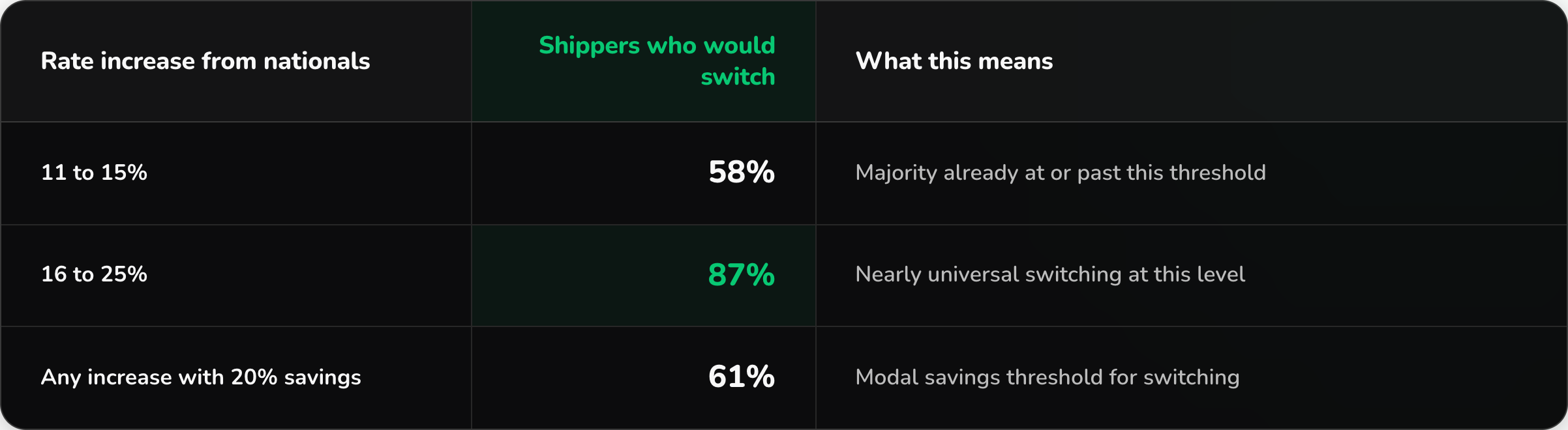
The modal tipping point shippers named was an 11 to 15% rate increase. FedEx and UPS annual general rate increases have held at 5 to 8% in recent years. Cumulative effective increases since 2020 exceed that 11 to 15% threshold. Shippers are not waiting for a future trigger. Many of them have already reached the threshold they said would make them move, and the adoption data confirms it.
For 3PLs, this means two things. First, your clients who have been asking about alternative carriers are not asking out of curiosity. They are at or past their own switching threshold and are evaluating whether their 3PL can support that move. Second, your ability to route across multiple carriers and bill for them accurately is increasingly a client retention capability, not just an operational preference.
FedEx and UPS Are Leaving Volume Behind. It Is Not Coming Back.
The Tusk report is direct about what is happening on the carrier side. FedEx and UPS are deliberately shrinking their networks. They are closing facilities, reducing capacity in e-commerce, and repositioning toward higher-margin B2B, healthcare, and premium freight. As we covered in our own blog post on this earlier in August, UPS volume fell 3.3% year over year in the most recent quarter, and it fell by design.
The Tusk report frames this precisely: the volume FedEx and UPS are leaving behind is not disappearing. It is moving to the carriers built to serve it at a lower price. Regional, local, and alternative last-mile providers are absorbing that volume. Shippers waiting for the nationals to come back for their volume will be waiting indefinitely. That volume is no longer part of those carriers' strategy.
For 3PLs, this is the operational reality that makes carrier diversification urgent rather than optional. The carrier mix that served your clients well in 2022 is not the same carrier mix that will serve them best in 2026. The lanes where UPS and FedEx were the obvious choice are the exact lanes where alternative carriers have been gaining ground, often at better economics.
Marketplace Platforms Are a Carrier Diversification Accelerant
One of the more surprising findings in the Tusk report is how marketplace platforms are affecting carrier strategy. 60% of shippers now sell on a marketplace, Amazon, TikTok Shop, or similar, that controls or influences how their orders are shipped. For 26%, the impact is significant enough to affect their overall shipping strategy.
The instinct is to read this as a constraint. The more interesting take, which the report surfaces, is that marketplace-constrained shippers are using their remaining self-directed volume specifically to test and expand with alternative carriers. 28% of those affected by marketplace shipping requirements say they are actively using their self-directed volume as an opportunity to pilot alternatives.
The marketplace is functioning as an unexpected accelerant to carrier diversification. Shippers who are being pushed out of their usual carrier patterns by marketplace requirements are discovering that alternative carriers work on the volume they control, which builds the confidence to diversify further.
What Shippers Say They Need to Make the Move
The adoption requirements shippers listed in the Tusk report are:
- 57% need faster or comparable transit times
- 56% need proven reliability data
- 49% need coverage in key shipping zones
- 40% need seamless integration with existing technology
- 36% need a centralized platform to manage multiple carriers
The report makes an observation that the 3PL industry should understand: everything on this list already exists. Transit data on alternative carriers shows they frequently match or outperform national carriers within their service territories. Reliability records are available. Coverage has expanded measurably. The gap is not capability. It is awareness and infrastructure.
The platform finding is the one most relevant to how 3PLs evaluate their own tech stack. 87% of shippers said a centralized platform for tracking, claims, and rate management would make them more likely to adopt alternative carriers. That number has been consistent across two consecutive years of the Tusk survey. Shippers know what they need. The operators who can provide it have a meaningful advantage in client conversations.
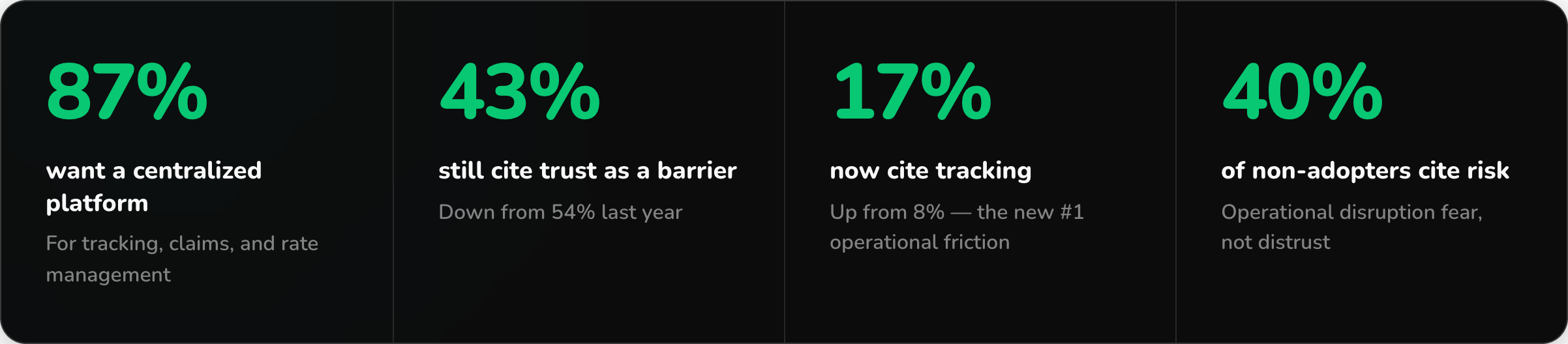
The 40% figure on operational risk is particularly relevant for 3PLs advising clients. The biggest reason shippers who have not yet tried alternative carriers have not done so is not skepticism about the carriers themselves. It is fear of disruption to their operations. That is a solvable problem with the right implementation support, and it is an opportunity for 3PLs who can position themselves as the operator that makes alternative carrier adoption low-risk.
What This Means If You Are Running a 3PL
Your clients are already at or past the rate increase threshold where they said they would explore alternatives. They are increasingly selling on marketplaces that are pushing them toward carrier experimentation. They want a centralized platform to manage the complexity that comes with a broader carrier mix. And they are choosing the 3PLs who can help them navigate this environment over those who cannot.
The operational requirements that shippers listed, transit data, reliability records, coverage visibility, centralized rate management, are the same capabilities that determine whether a 3PL can route intelligently across a diversified carrier mix and bill for it accurately. They are not separate conversations.
The 3PLs who are positioned well for this market are the ones who already have a multi-carrier routing capability that evaluates live cost and performance data, a billing system that handles any carrier's surcharge structure without a manual update cycle, and the ability to show clients exactly what every carrier is costing and delivering on every lane.
That is what DiversiFi's AI Carrier Routing and AI Dynamic Billing are built to do. When your clients come to you asking about alternative carriers (which the Tusk data suggests is happening or will happen soon), the answer should not be a routing guide built two years ago and a billing spreadsheet that needs to be updated every time a carrier changes their surcharge schedule. It should be a live system that evaluates the full carrier picture and captures every charge accurately.
The alternative carrier shift is already here. The 3PLs who get ahead of it will have a meaningfully stronger client story for the next several years.
Where to Read the Full Report
The 2026 Tusk Alternative Carrier Benchmark Report is available on their website. It is one of the most data-rich looks at alternative carrier adoption published this year, and the full version includes the complete carrier awareness and trust table across 17 carriers, the full breakdown of adoption barriers, and the geographic coverage data.
If you want to talk through what carrier diversification means for your specific routing and billing setup, that is a conversation DiversiFi is well positioned to have. The infrastructure question behind alternative carrier adoption is exactly the problem our platform is built to solve.
Frequently asked questions
What is AI carrier routing and how does it work for 3PLs?
How should 3PLs handle unexpected carrier rate increases?
What are carrier surcharges and how do they affect 3PL margins?
Continue learning


See AI for your 3PL In Action
Discover how our solutions can drive your success.