

UPS and FedEx Are Exiting Low-Margin Parcel. What That Means for 3PLs Who Depend on Them.

Something significant shifted in the parcel carrier market this week, and it deserves more attention than it is getting in most logistics conversations.
UPS reported strong quarterly earnings, beating both revenue and margin expectations. That sounds like good news. But volume fell 3.3% year over year. And the reason it fell is the reason every 3PL operator who routes through UPS or FedEx should be paying close attention right now.
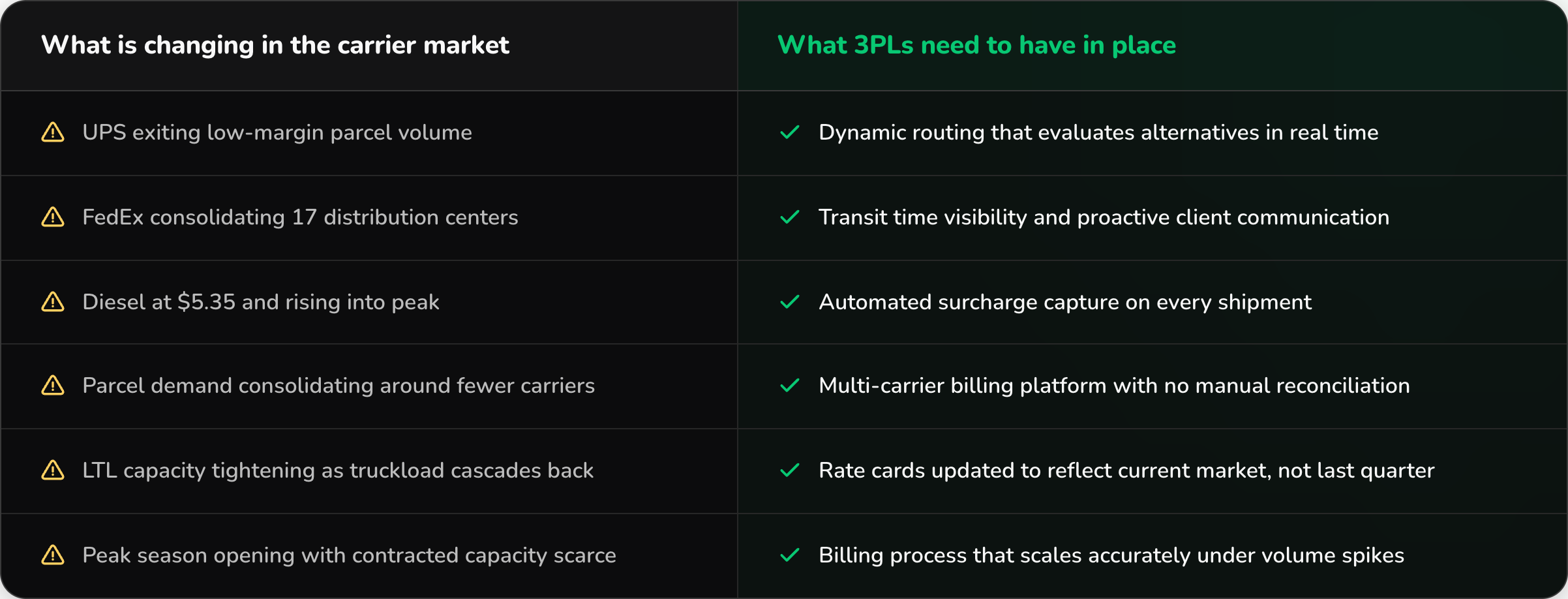
UPS is not losing volume because the market is soft. It is deliberately exiting low-margin e-commerce business and concentrating on healthcare and automotive freight where yields are higher. At the same time, FedEx is closing 17 distribution centers as part of its Network 2.0 consolidation, eliminating redundant capacity and concentrating volume at larger hubs. Diesel is sitting at $5.35 per gallon after surging 13.8% in just four weeks. And peak season freight is building just as carrier capacity is tightening.
For 3PLs, this is not background noise. This is a fundamental shift in how the two carriers that dominate domestic parcel are positioning themselves for the next phase of the market. And the operators who understand what it means for their routing decisions, their billing, and their client conversations will be in a significantly better position than those who are still treating UPS and FedEx as the default answer to every parcel shipment.
The Numbers Behind the Shift

Those four numbers tell a connected story. The two largest parcel carriers are shrinking their addressable market by design. Capacity is coming out. Rates are elevated and not expected to return to prior norms. And fuel costs have just reset upward again after a brief June reprieve that many shippers had already priced into their Q3 forecasts.
The freight market, per Transportation Insight's August 2026 market update, is not returning to normal. It has reset to a new normal. Operators who are planning around a reversion to pre-2025 carrier pricing are building their business on an assumption that the data does not support.
What UPS Is Actually Doing and Why It Matters
UPS's volume decline is not an accident or a symptom of losing to a competitor on price. It is the intended output of a deliberate strategy to exit low-yield business and replace it with higher-margin freight.
The clearest example of this is Amazon. UPS spent years as a primary carrier for Amazon's seller network. That relationship generated enormous volume. It also generated pressure on rates that UPS decided was no longer worth it. Over the past 18 months, UPS has methodically reduced its Amazon exposure, redirecting that capacity toward healthcare logistics, automotive parts, and other verticals where the economics are more favorable.
What this means for 3PLs is straightforward. If your parcel routing has historically defaulted to UPS on lanes where they were the volume leader, you are now competing for capacity that UPS has decided it would rather deploy elsewhere. The lanes where UPS pulled back are not being absorbed by a price reduction. They are being absorbed by tighter availability and less competitive pricing on the remaining volume they do want.
The 3PLs who recognized this shift early and started diversifying their carrier mix are in a better position than those who are still treating UPS as the automatic first call on every parcel shipment.
What FedEx Is Actually Doing and Why It Matters
FedEx's Network 2.0 consolidation is a different kind of story, but it points to the same conclusion.
Closing 17 distribution centers sounds like a company retreating. The reality is more strategic. FedEx is eliminating facilities where volume is too thin to justify the fixed costs, concentrating freight at larger hubs where it can be handled more efficiently, and integrating its historically separate air and ground networks into a single unified system.
For 3PLs, the practical effect is that some lanes that previously had strong FedEx ground coverage will see service time extensions as freight moves through consolidated rather than local facilities. Shippers who have become accustomed to specific transit times on specific lanes may find that those times have quietly extended, which creates a client expectation problem if it is not addressed proactively.
There is also a capacity math implication. When FedEx removes distribution center capacity from the network, the available handling capacity for new volume on those lanes decreases. Going into peak season, that is a meaningful constraint.
The Carrier Diversification Conversation 3PLs Need to Be Having
The combined effect of what UPS and FedEx are doing is that parcel demand is consolidating around fewer carriers even as the two largest carriers pull back from segments of the market. That creates a gap, and gaps in logistics markets tend to get filled.
DHL Express is actively filling some of that space, winning volume on competitive lanes where UPS and FedEx have raised prices or reduced service intensity. Regional carriers are picking up lanes that no longer fit the national network economics of the major players. And for certain freight profiles, the math on alternative routing is changing fast.
The 3PLs best positioned to navigate this are the ones who are not locked into a carrier routing strategy that was designed for the market of 18 months ago. Dynamic carrier routing, where the routing decision is made based on current cost and performance data rather than a static guide, is no longer just a margin optimization tool. It is becoming an operational necessity.
The Billing Problem That Comes With Carrier Shifts
Here is the piece that most 3PLs are not thinking about when they discuss carrier strategy: every time your carrier mix changes, your billing has to change with it.
When you add a new carrier to your routing mix because UPS has pulled back on certain lanes, that carrier comes with its own surcharge schedule, its own invoice format, its own accessorial fee structure, and its own billing cycle. If your billing process requires manual updates to rate cards and surcharge schedules when you bring on a new carrier, every carrier diversification decision creates a new billing risk.
The 3PLs running on manual billing processes are going to find carrier diversification harder than it needs to be. Every new carrier means new data to gather, new rates to configure, new surcharges to track, and new invoice formats to reconcile. The operational overhead of keeping up with a shifting carrier mix is one of the strongest arguments for automating your billing foundation before you need to change it under pressure.
When billing is automated and carrier data flows directly into the system, adding a carrier to your routing mix does not create a billing project. It is a configuration update that the platform handles. The invoice output is accurate from the first shipment on the new lane.
What the Broader Market Is Telling 3PLs Right Now
Pull back from the individual carrier moves and the picture is consistent across every signal in the August 2026 freight market.
Truckload all-in rates remain roughly 50% above year-ago levels despite recent pullbacks from peak. Tender rejection rates have eased from 17.65% to 14.1%, but that is still three times last year's baseline. ISM Manufacturing PMI hit 55.6% in July, the highest since May 2022 and the seventh consecutive month of expansion, which means industrial freight demand is growing. Private consumption is rising. Peak season is opening into a market where carrier capacity has structurally contracted.
This is not a soft freight market with a challenging rate environment. This is a tight freight market where the operators who have their routing, billing, and client communication processes in order are going to perform significantly better than those who are reacting to each development as it arrives.
The Practical Question for Every 3PL Operator
Here is the question worth sitting with after reading through what UPS and FedEx are doing.
If your two largest parcel carriers are both deliberately pulling back from segments of the market at the same time that diesel is at a multi-year high and peak season is opening, is your routing strategy and your billing infrastructure built to handle that?
Not eventually. Right now. Because the window to get ahead of peak season is closing this week, not next month.
The 3PLs who are going to come out of this period in the strongest position are the ones who diversified their carrier mix before they had to, automated their billing before volume spiked, and have real-time data on what every carrier lane is actually costing them. Those are not aspirational capabilities. They are available today.
DiversiFi's AI Carrier Routing evaluates your full carrier mix against live cost and performance data so routing decisions reflect the current market rather than a guide built for a different one. AI Dynamic Billing ensures that every carrier you add to your mix, every surcharge change, and every invoice from every carrier is captured and billed accurately without manual intervention. And as the carrier landscape shifts going into peak, that combination is not just an efficiency tool. It is margin protection.
If you want to see what your current routing strategy is actually costing you given the current carrier environment, we can model that out. Most operators find there are more dollars on the table than they expected once the routing data is in front of them.
Peak season does not wait. Neither does the carrier market.
Frequently asked questions
Should 3PLs be worried about Amazon entering the logistics market?
What is AI carrier routing and how does it work for 3PLs?
What is a fuel surcharge and why does it change so frequently?
Continue learning

See AI for your 3PL In Action
Discover how our solutions can drive your success.