


0 Signed Agreements for Slow 3PLs. What the Third Person Fulfillment Index Tells 3PLs about 2026

Third Person just published the first edition of the Fulfillment Marketplace Index, a semi-annual data digest covering over 3,000 brand-to-3PL connections made on their marketplace between January and June 2026. It's a substantial amount of behavioral data pulled from actual buyers reaching out to actual providers, which makes it some of the cleanest demand-side research the fulfillment industry has seen.
Matt Hertz, founder and CEO of Third Person, put it directly:
Most fulfillment benchmarks blend every brand into one average that doesn't actually describe anyone. We're sitting on thousands of real brand-to-3PL outreaches — actual buyers raising their hands — so we wanted to publish what in-market demand really looks like instead of another survey of opinions.
We read the full report and the findings are powerful yet very clear, especially for the owner-operated 3PLs who make up the majority of the market. Here is what stood out to us and what it means for how 3PLs compete.
The Market Is Active and Getting More Competitive
The headline numbers from H1 2026 are strong. Third Person recorded 3,000+ brand-to-3PL connections across the half, with 1,000+ unique brands beginning their 3PL search and 300+ 3PLs receiving at least one lead. In-market demand climbed steadily through the half, with monthly connections more than quadrupling from July 2025 to the peak months of H1 2026.
The number that tells the real competitive story is 3.7. That is the average number of 3PLs a brand contacts during their search. For enterprise brands shipping more than 10,000 orders per month, that number climbs to 5.4, with more than half of those brands contacting five or more providers.
The takeaway from Third Person is clear: brands are shortlisting, not selecting. Being the second or third 3PL they reach out to does not disqualify you. What disqualifies you is being slow.
Speed to Quote Is Not a Differentiator. It Is the Requirement.
These are the findings that should stop every 3PL operator mid-scroll.

Every single deal that closed in the first half of 2026 went to a 3PL that responded within a week. Not most deals. Every deal. And three quarters of all leads in the system went to same-day quoters specifically.
The behavior that separates 3PLs winning business from everyone else is speed. Every single signed deal this half went to a provider that quoted within a week, and three-quarters of all leads went to same-day quoters. Being the second or third 3PL a brand contacts still wins the deal — as long as you respond fast.
Matt Hertz, Founder and CEO, Third Person
For most 3PLs, this is not a motivation problem. It is a process problem. When a lead comes in, your sales team has to gather shipment data, pull current carrier rates, model the margin, and put together something credible before they can respond. That process, done manually, takes time that brands are not willing to wait.
This is exactly the gap DiversiFi's Bid Boost was built to close. When your carrier costs, rate cards, and pricing logic are already in the platform, responding to a new lead with an accurate, margin-visible proposal is a matter of hours rather than days. The v3 BidBoost pipeline, which we shipped this month, processes 10,000 shipment records in under five minutes. That is the kind of speed that puts you in the top percentile in the industry.
The Market Is Winner-Take-Most, and the Winners Are Not Who You Think
The lead distribution in the Third Person data is notably concentrated. The top 10% of 3PLs captured 53% of all connections in H1. The single most-contacted provider fielded 106 leads.
But here is what the report makes clear: the 3PLs capturing disproportionate lead flow are not winning because they are bigger or better resourced. They are winning because of two specific behaviors that are entirely within any operator's control.
First, profile depth. Among 3PLs who listed 41 or more capabilities on their Third Person profile, 71% received at least one lead in H1. Among those with 11 to 25 capabilities listed, only 42% did. The algorithm rewards completeness, and so do brands.
Second, speed to quote. We covered this above, but it bears repeating in this context. The concentration of leads at the top of the market is a behavioral outcome, not a structural one. The 3PLs in the top 10% are not a different category of business. They are the same owner-operated operators that make up 84% of the network. They just respond faster and present more completely.
There Is No Average Brand. The Pitch That Closes One Loses the Other.
There's no such thing as an average brand. A pre-launch founder shipping a few hundred orders and an established operator moving 50,000 come through the same door, but they buy completely differently — different urgency, different vocabulary, different definition of winning. The pitch that closes one loses the other.
Matt Hertz, Founder and CEO, Third Person
The Third Person volume tier data backs this up specifically. Three distinct buyer profiles emerge from the H1 data, and they require meaningfully different approaches.
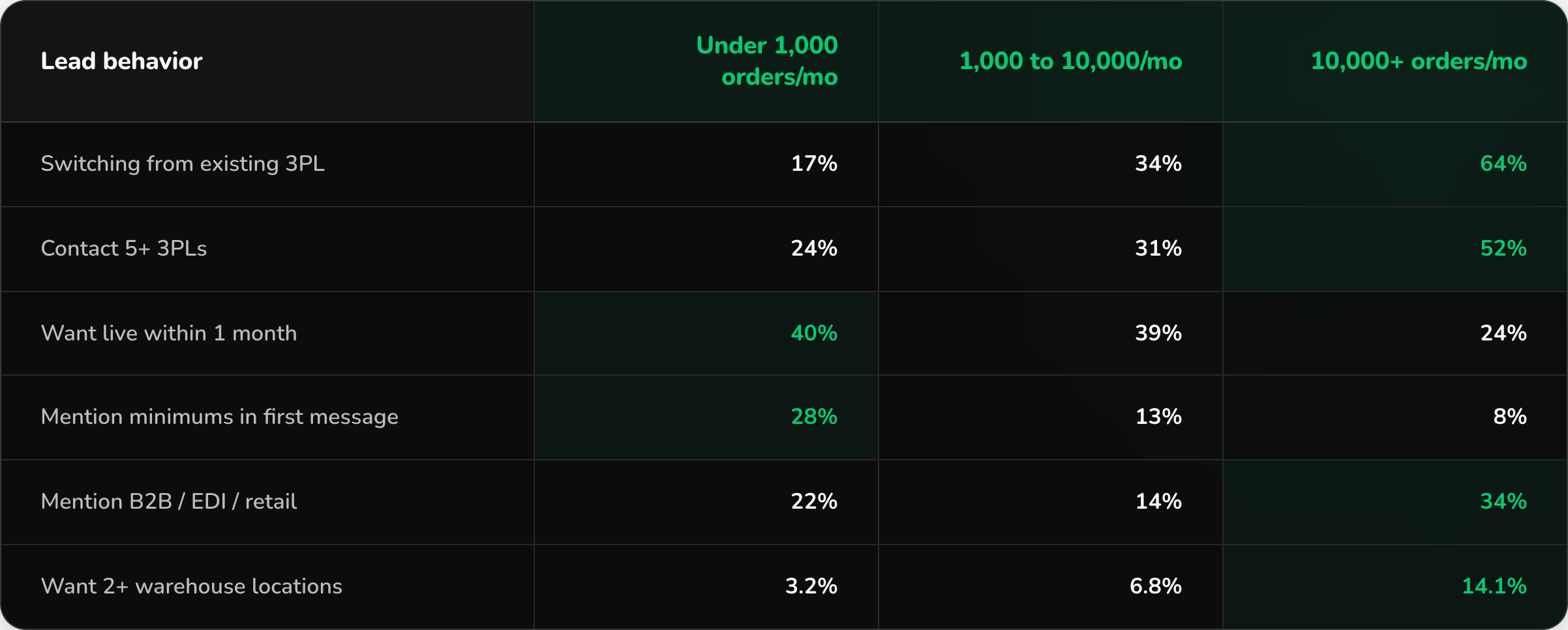
Small brands are largely first-time outsourcers in a hurry. They are worried about minimums, want to go live within a month, and their first messages to 3PLs focus on launch timing and returns. They are buying a first-ever partner, and the pitch that wins them is accessibility and speed.
Enterprise brands are doing something structurally different. Nearly two thirds are switching from an existing provider, more than half contact five or more 3PLs, and their outreach language is dominated by terms around wholesale and transitions. They are running a structured competitive process, and the pitch that wins them is capability, multi-node coverage, and credibility in handling complex operations.
The implication for 3PLs is that a generic proposal template loses at both ends. Knowing which tier you are pitching, and tailoring your response to their specific vocabulary and priorities, is one of the highest-leverage changes a sales team can make. DiversiFi's BidBoost surfaces the margin and cost data that makes that kind of specific, confident proposal possible at speed.
Texas Is the New Center of Gravity
Texas has quietly become the center of gravity for fulfillment. Dallas-Fort Worth drew more brand demand than any other metro in the country, and Texas out-pulled California by roughly a third. The coasts still have the most warehouses, but the middle of the country is where the leads are going per facility.
Matt Hertz, Founder and CEO, Third Person
The geographic data in the Third Person report is one of its most actionable findings. West Coast warehouses are the most numerous in the network but the most underutilized per facility, generating roughly half the leads per facility compared to the Midwest. The South and Midwest lead on a per-facility basis, with Texas in particular outperforming every other state on total lead flow.
Dallas-Fort Worth was the single most-contacted metro for brand connections in H1 2026. Texas as a state out-pulled California by roughly a third on total lead flow despite having fewer facilities.
For 3PLs with Texas presence, or those considering where to add capacity, the data is unambiguous. For 3PLs on the coasts, it is a reminder that geographic positioning is increasingly part of the competitive story, and that being in a high-demand region with good per-facility utilization is a different asset than simply being in a large market.
What Brands Are Actually Asking For
The capability data from Section 7 of the report gives 3PLs a clear picture of what brands expect as baseline requirements versus genuine differentiators.
E-commerce fulfillment and Shopify integration are table stakes. Returns processing, at 55% of brands requiring it, is now an expectation rather than a value-add. Kitting, at 20%, and Amazon FBA prep, at 15%, are the capabilities where differentiation starts.
The language brands use in their first outreach messages is equally revealing. Pricing and rates top the list at 49% of messages, which is expected. But the second tier is where the real insight lives. Scale and growth are mentioned by 43%. Pre-launch language appears in 35%. B2B and retail EDI in 22%. And 18% of brands reference a desire for direct human contact in their very first message, specifically calling, texting, or Slack.
That 18% number is worth thinking on. Nearly one in five brands open their search by signaling that they want a relationship, not just a service. They are filtering for responsiveness and personality before price even enters the picture. For owner-operated 3PLs, that is a competitive advantage that no PE-backed national platform can easily replicate.
The One Thing Every Winning 3PL Had in Common
The median time from first connection to signed agreement in H1 2026 was 33 days. The behavior that compressed that timeline, consistently, across every deal that closed, was quoting within a week.
The report is clear about this. Profile completeness helps. Geographic positioning matters. Capability depth wins enterprise deals. But the single behavior present in 100% of signed agreements was speed to quote.
For most 3PLs, the barrier to speed is not willingness. It is the manual process that sits between receiving a lead and having something credible to send back. Gathering the right shipment data, running the rate analysis, applying current surcharges, modeling the margin, and presenting it in a way that makes sense to a brand evaluating three other providers at the same time, all of that takes time when it is done by hand.
DiversiFi removes most of those manual steps. Your carrier costs are in the platform. Your rate logic is configured. The margin is visible before you finalize anything. The new v3 BidBoost pipeline handles files of any size in minutes. What used to take a day of work before you could respond now takes an hour or less.
In a market where every signed deal went to a sub-one-week quoter, an hour of turnaround time is not a marginal improvement. It is the difference between being in the game and being on the outside of it.
Where to Read the Full Report
The Third Person Fulfillment Marketplace Index H1 2026 is available at Third Person's website. It is one of the better data sets published on real fulfillment demand this year, and the full report goes deeper on geographic breakdowns, WMS fragmentation across the 3PL network, and channel mix trends including TikTok Shop emerging as a fast-growing new requirement.
If you want to see how DiversiFi helps 3PLs close the speed-to-quote gap that the report identifies as the single clearest driver of winning business, we can walk you through it. The data in this report is exactly the kind of signal we built the platform around.
Frequently asked questions
How do 3PLs respond to RFPs effectively?
How do bidding tools help 3PLs win more business?
What is 3PL bidding software?
Continue learning



See AI for your 3PL In Action
Discover how our solutions can drive your success.