

The FedEx 2027 GRI Is Here. The Headline Is 5.9%. The Real Story Is Underneath It.

FedEx just announced its 2027 General Rate Increase, effective January 4, 2027. The headline number is 5.9%, which is exactly what it was in 2024, 2025, and 2026. Four consecutive years at the same published average.
That consistency is the story the headline is designed to tell. The story underneath it is different.
The 2027 GRI is structurally the most significant change FedEx has made to its rate table since 2023. The long-haul targeting that defined last year is gone. In its place is a flat Ground table that removes the negotiation angles operators had been using, a light-package squeeze that lands on exactly the volume e-commerce operations move most, minimum charges that keep outrunning base rates, and accessorial fees climbing well above the headline average.
For 3PLs, the 5.9% headline is the starting point for the conversation, not the answer. Here is what is actually in the 2027 FedEx GRI and what it means for how you bill your clients and route your freight.
The Numbers That Matter
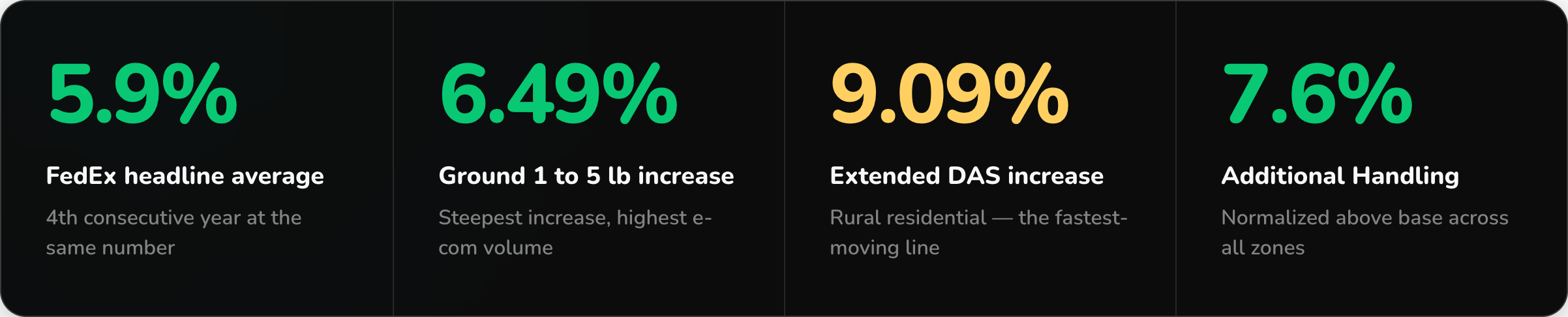
Five of the seven major FedEx services land above the 5.9% average in the 2027 table. Express Saver is the outlier at 3.09%, and that single carve-out is what mathematically pulls the blend back to the headline. Remove Express Saver from your shipping mix and your effective increase is already past the announced number before you account for accessorials.
That gap between the headline and what actually lands on a 3PL's billing cycle is where margin gets absorbed quietly. And it is exactly why billing accuracy against live carrier data matters more in a GRI year than at any other point in the contract cycle.
Ground Goes Flat Across Every Zone. How That Changes Your Negotiation.
For two years running, FedEx loaded above-average increases into Zones 7 and 8, where long-haul volume is hardest to shift to regional alternatives. Operators who understood that dynamic built zone-specific negotiation strategies around it.
The 2027 GRI removes that angle. Ground increases now run within eight basis points across the entire zone table. Zone 2 at 6.08%. Zone 5 at 6.09%. Zone 7 at 6.15%. Zone 8 at 6.11%. It is effectively a uniform 6.1% applied everywhere.
When the increase is uniform, the negotiation has to be uniform too. Surgical asks on a handful of long-haul lanes no longer have the same leverage. The counter has to be base discount improvement across the full table, or a restructuring of how earned discounts are calculated.
There is also a competitive tidbit here. A flat zone table is unusual. FedEx has been loading zone-specific increases for two years, and regional carriers have been taking short-zone Ground volume during that same period. The flat table in 2027 reads as a response to that pressure, which tells you something about where FedEx sees its vulnerability. That information is valuable in your rate conversation.
Light Packages Are the New Target.
Last year FedEx applied above-average increases to the 11 to 20 pound bracket. For 2027, the pressure moved down the weight curve to the packages that make up the bulk of e-commerce volume.
FedEx Ground weight break increases now run:
- 1 to 5 lbs: 6.49%
- 6 to 10 lbs: 6.22%
- 11 to 20 lbs: 6.26%
- 21 to 30 lbs: 5.72%
- 31 lbs and above: 6.09%
The lightest packages carry the steepest increase, and the 21 to 30 pound bracket, which is not typical e-commerce freight, got the smallest increase of any weight band.
For 3PLs moving high volumes of lightweight parcels, this compounds directly with the minimum charge increase below. Both changes land on the same packages. Neither shows up in the headline.
Minimum Charges Keep Outrunning Base Rates.
The FedEx Ground minimum charge rises from $11.99 to $12.70 in 2027, a 5.92% increase. That does not sound dramatic until you compound it. Two years ago the Ground minimum was $11.32. In two years it has moved to $12.70, a compounded 12.2% increase on the floor.
Four of five FedEx service minimums are rising faster than the base rates on those same services. Standard Overnight is the clearest example: base rates up 5.16%, but the minimum charge up 5.88%.
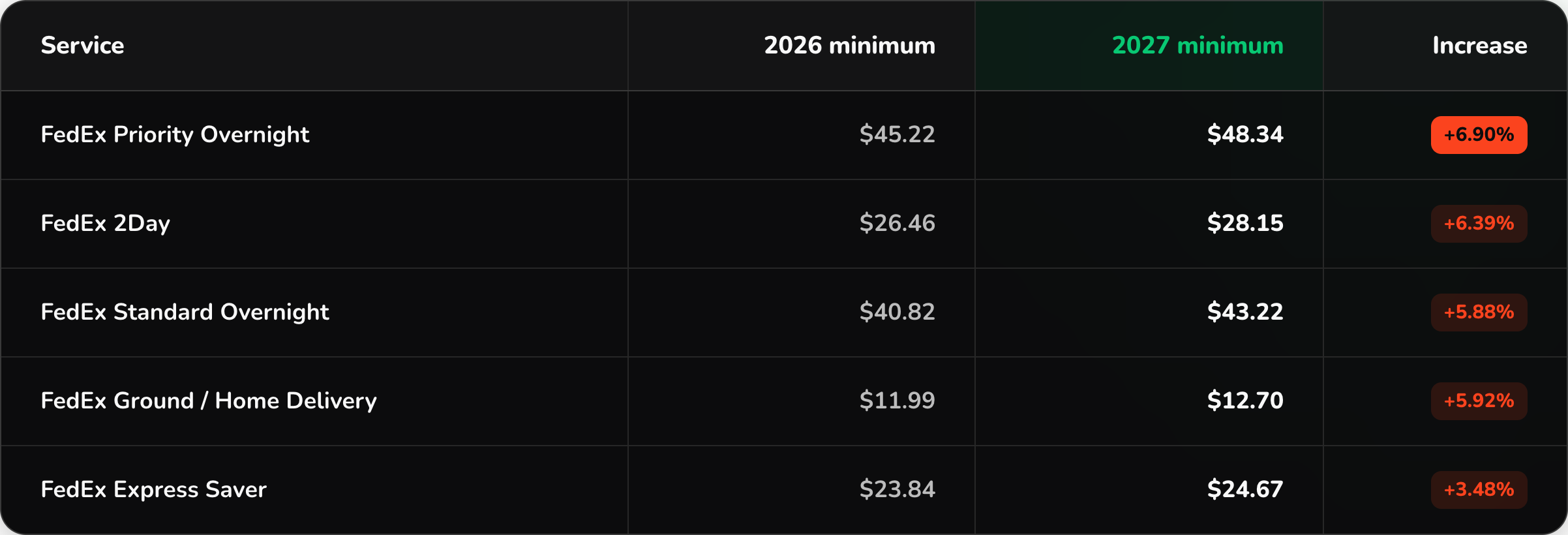
The minimum charge is not a floor you occasionally touch. For lightweight, short-zone shipments, it is the rate you actually pay on a meaningful share of your volume. Every point of minimum charge increase erases a point of negotiated discount on those packages, and base rate concessions do not fix it. The minimum has to be negotiated separately, and it is the term carriers resist most.
For 3PLs billing clients on a pass-through or cost-plus model, a minimum charge increase that is not captured in the billing system is margin absorbed on every qualifying shipment in every billing cycle.
Accessorials Are Climbing Faster Than the Headline.
The 2027 GRI normalized Additional Handling at a flat 7.1% to 7.6% across all zones and all three triggers, weight, dimension, and packaging. For context, these were moving unevenly last year, with some zones up more than 11% while others moved less than 6%. FedEx appears to have finished re-basing that surcharge and is now escalating it as a single block above the headline rate.
Extended Delivery Area Surcharges are moving faster still. Extended residential is up 9.09%. Extended Ground is up 8.11%. Rural residential delivery is where FedEx is pricing hardest in 2027, and it is doing so at roughly 1.5 times the base rate increase.
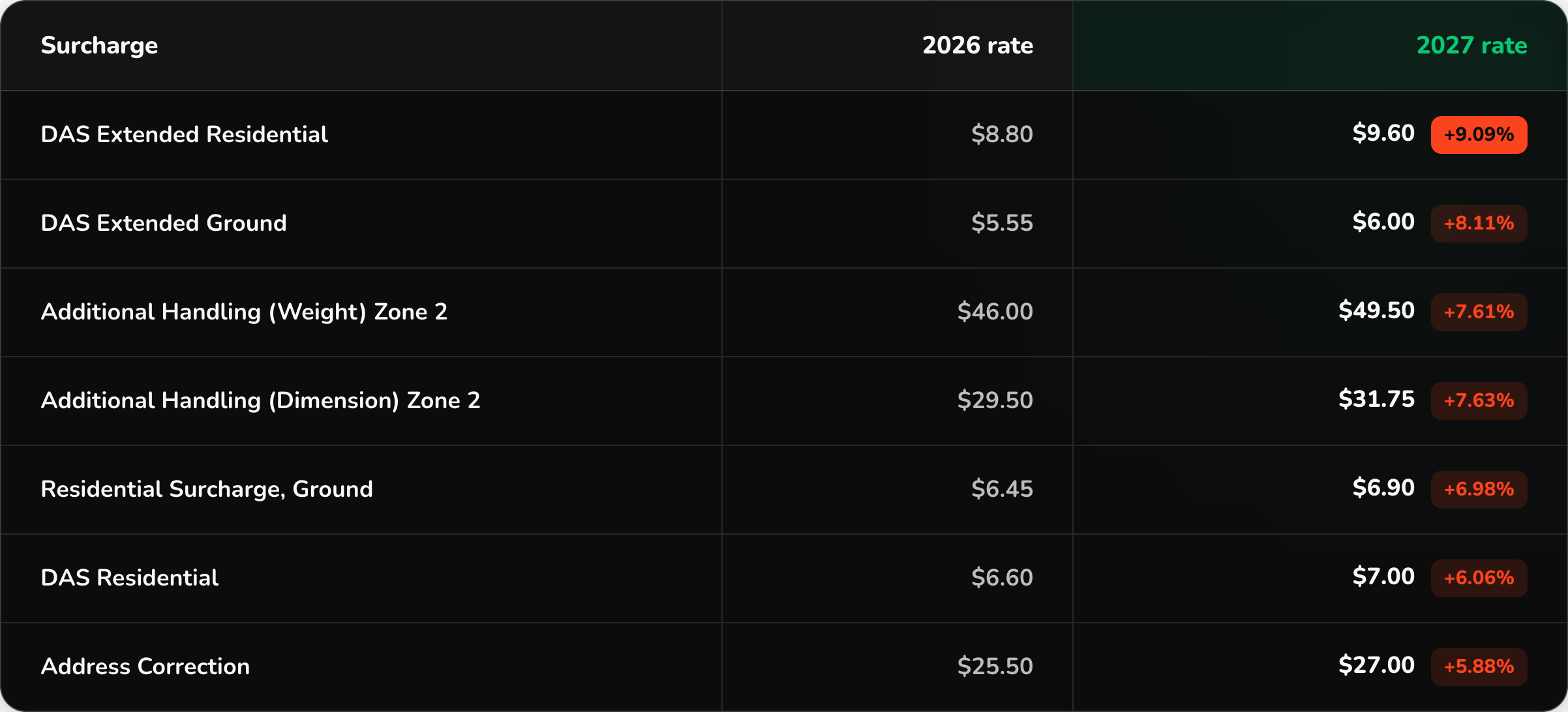
There is a compounding dynamic here that the headline does not capture. Most accessorial discounts are negotiated as a percentage off published rates. When the published rate climbs 7.6% and the discount percentage stays flat, the actual cost climbs 7.6% right along with it. These fees also stack on top of base rates and on each other, and because many are subject to fuel surcharge application, their effect on the final invoice is consistently larger than the table alone suggests.
For 3PLs, this is especially important in billing. If your billing system is applying last year's accessorial rates or calculating discounts off stale published amounts, the error is not flat. It compounds with volume.
Express Saver Was Held to 3.1%. Here Is Why That Matters.
FedEx does not leave three points of yield on the table by accident. Express Saver came in at 3.09% against a backdrop where every other service moved between 5.16% and 6.65%. The Express Saver minimum charge rose just 3.48%, while every other minimum moved between 5.88% and 6.90%.
This is a competitive move. The most likely explanation is that FedEx is protecting deferred air volume from trading down into Ground, or defending against UPS 3 Day Select and other deferred products in the market.
Either way it creates an opening for shippers and 3PLs with transit-tolerant freight currently moving on 2Day. The spread between 2Day and Express Saver widened by more than three points in 2027. That gap tends to close in the following GRI, which means the window to model the Express Saver alternative and use it in your next carrier conversation is now, not in twelve months.
The Cumulative Picture: Four Years of 5.9%
Here is the number that rarely gets talked about in GRI season: the cumulative impact of four consecutive years at 5.9%.
A base rate of $10.00 in 2023 is now approximately $12.49 in 2027 after four rounds of compounding at 5.9%. That is a 24.9% effective increase on the base. Stack the accessorial increases, the minimum charge movements, and the fuel surcharge resets on top of that, and the total cost impact since 2023 is materially higher than any single-year announcement suggests.
FedEx has held the headline flat while the backdrop moved. Inflation has risen from roughly 2.9% when the 2026 GRI was written to approximately 3.4% now. The carrier has been running the same percentage regardless of where inflation sits, which signals the 5.9% is a yield target, not a cost pass-through. That is worth bringing up in a negotiation conversation.
What This Means for 3PLs Right Now
The 2027 GRI creates three immediate action items for 3PL operators before January 4.
First, update your rate cards and billing system to reflect the 2027 table, not just the headline percentage (or don't do a thing if you're a DiversiFI client). The weight break changes, the minimum charge increases, and the accessorial movements all land differently depending on your client's shipment profile. Applying a flat 5.9% across the board will undercharge or overcharge on almost every account.
Second, model the client impact at the account level before the increase takes effect (or again, have DiversiFi do it for you). The 3PLs who have that conversation proactively, before the client sees it on an invoice, are having a different kind of relationship discussion than those who send a revised rate card in January with no context. The data is available now. The conversation can happen now.
Third, evaluate your carrier mix before January. The 2027 FedEx GRI, stacked on top of what UPS is likely to announce in the coming weeks, is another data point in a cumulative cost environment that has been building for four years. The operators who have already diversified their carrier mix are in a position to route around the sharpest increases. The ones who have not are absorbing them fully.
GRI season is the moment every year when the gap between operators who have automated billing and those who have not becomes most visible. The carriers make their move in September and October. The billing impact lands in January. The window to get ahead of it is the one you are in right now.
If you want to understand how the 2027 FedEx GRI specifically affects your billing and client rate structures before January, we offer free cost modeling. We can show you the exact impact on your shipment profile before any client conversation happens.
Frequently asked questions
How does 3PL billing software handle GRI updates?
How should 3PLs handle unexpected carrier rate increases?
How does AI dynamic billing work?
Continue learning


See AI for your 3PL In Action
Discover how our solutions can drive your success.