

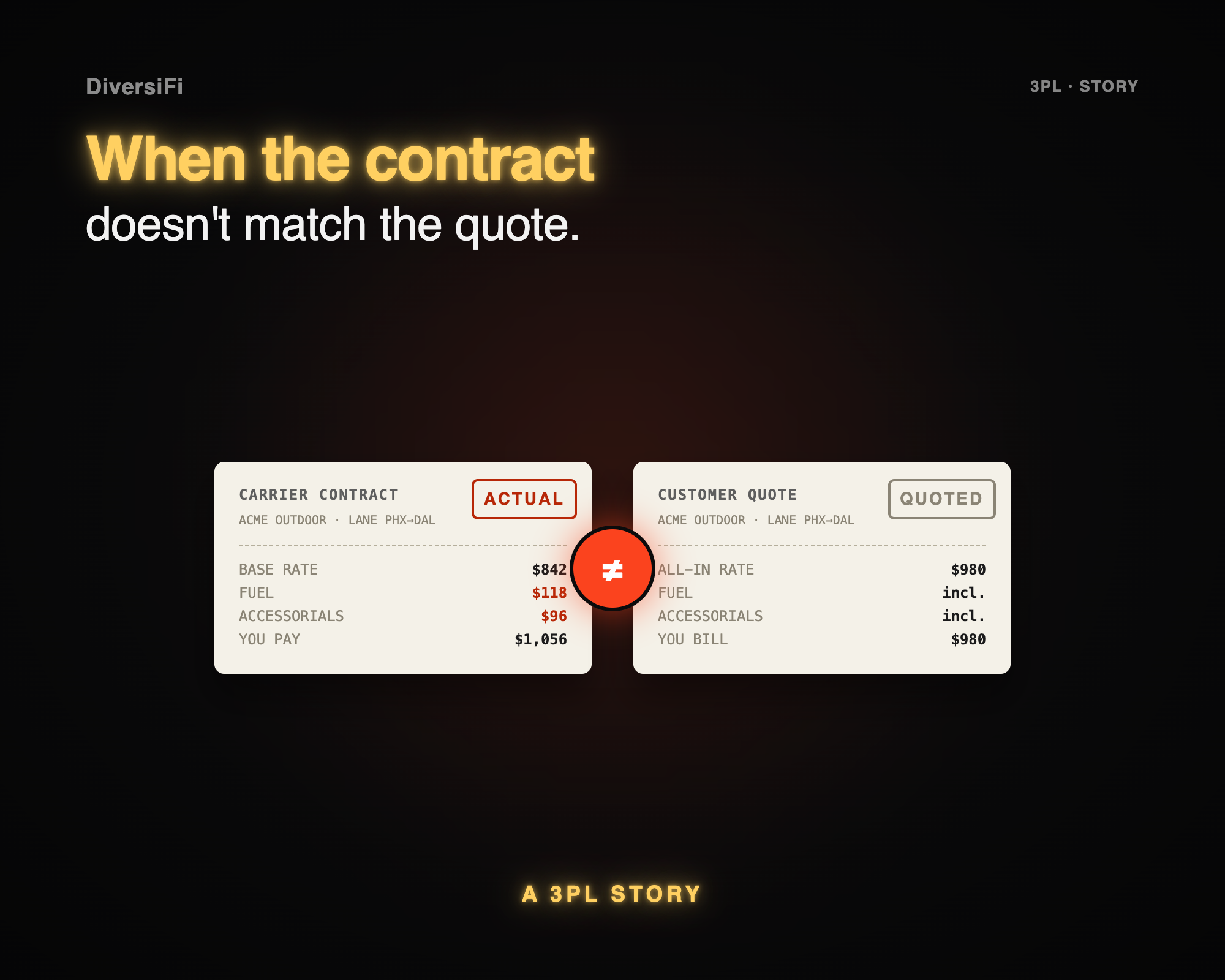
What Happens When Your Carrier Contract Doesn't Match Your Customer Quote: A 3PL Story

It usually starts with a number that doesn't look quite right.
Maybe it's a carrier invoice that comes in higher than expected on a lane you've been running for months. Maybe it's a client's billing question that sends you digging through a rate card you haven't looked at since the contract was signed. Maybe it's a margin report that shows an account performing well below where you thought it was sitting.
However it surfaces, the discovery is the same: somewhere between the rate you quoted the client and the rate the carrier is actually charging you, there's a gap. And in a business where margins are already thin, that gap has been quietly costing you money and probably for longer than you'd like to admit.
This post walks through how that gap forms, what it costs, and what it takes to make sure it doesn't happen again.
A Story That Sounds Familiar
Let's walk through a scenario. It's a composite, built from situations that play out in 3PL operations all the time, but if you've been running a 3PL for more than a year, parts of it are going to feel pretty specific.
A mid-size 3PL wins a new client: a direct-to-consumer brand shipping about 4,000 packages a month, mostly residential, mostly ground. The sales team quotes based on their current UPS contract and adds a standard markup. The deal closes. Onboarding goes smoothly. The account looks good.
Three months later, UPS rolls out its quarterly surcharge update. Ground fuel surcharges tick up. The residential delivery fee gets a small adjustment. Nothing dramatic, just the kind of incremental change that gets buried in a carrier update email that nobody has time to read carefully.
The billing team keeps generating invoices the same way they always have. The rate card in the spreadsheet doesn't get updated. Updating it means cross-referencing the new UPS schedule, recalculating the markup, and touching a file that's shared across the billing team. It's on the list. It just never rises to the top.
Six months in, someone pulls a margin report. The account is running at about 60% of the margin it was projected to generate. The billing lead digs in. The carrier cost has moved. The client rate hasn't. Every shipment for the past several months has been billed at a rate that no longer reflects the actual cost structure.
The math: 4,000 shipments per month, average gap of $2.10 per shipment, six months. That's $50,400 in margin that was never captured. And the account is still running at the wrong rate.
Nobody made a bad decision. Nobody was negligent. A carrier rate changed, the billing process didn't catch it, and the gap compounded quietly until someone happened to look at the right report at the right time.
That's the nature of the carrier-to-quote mismatch problem. It's not a dramatic failure. It's a slow leak.
How the Gap Forms in the First Place
Understanding how this happens is the first step to preventing it. The carrier-to-quote mismatch isn't one problem:; it's three separate problems that often occur together.
1. Carrier costs change more often than most 3PLs track
Carrier pricing isn't static. Base rates update annually. Fuel surcharges adjust weekly or monthly based on published indices. Accessorial fees (residential, DIM weight, delivery area, address correction) get revised quarterly. General rate increases roll out every January and sometimes mid-year.
In 2026 alone: UPS ground fuel surcharges are at 22.25%, up from roughly 16% two years ago. FedEx ground is at 22.50%. USPS added an 8% fuel surcharge in April — the first in its history. Amazon added a 3.5% logistics surcharge for sellers. Every one of those changes represents a new gap between what carriers are charging and what 3PLs are billing if their rate cards haven't been updated.
The compounding effect is significant. A 3PL that hasn't updated its carrier cost inputs since Q4 2024 is working from a cost baseline that's materially lower than what they're actually paying today. Every quote built on that baseline is potentially underpriced. Every invoice sent without updated surcharges is leaving money on the table.
2. Client rate cards drift from actual cost structure
The second problem happens on the client side of the equation. When a client contract is signed, the rate card reflects the cost structure at that moment; carrier base rates, current surcharges, the operator's markup. Over time, as carrier costs move, that rate card drifts away from the underlying reality.
Most 3PLs have a process for annual contract renewals. Very few have a process for monitoring the gap between client rates and carrier costs in real time. That monitoring gap is where the margin leakage lives.
It's worth being specific about what this looks like in practice. A client contract signed 18 months ago might have been built on a UPS ground fuel surcharge of 16%. That same surcharge is now 22.25%. If the client rate card was built with the surcharge baked into a flat per-shipment rate rather than as a pass-through line item, the 3PL has been absorbing 6+ percentage points of surcharge increase on every ground shipment for the life of the contract. On 4,000 shipments per month at an average base rate of $8, that's roughly $1,920 per month in absorbed costs that were never in the original margin calculation.
3. The bidding process and the billing process aren't connected
The third problem is structural. In most 3PLs, the people who build quotes and win new business are working from different data than the people who process invoices and manage carrier relationships. Sales builds a quote using their best estimate of current costs. Operations runs the account. Billing invoices the client based on the rate card from the signed contract.
When carrier costs change, the information might reach the carrier management person before it reaches anyone involved in billing or pricing. By the time a new GRI or surcharge update actually makes it into the billing system, there's a gap (sometimes weeks, sometimes months) where every shipment processed is working from stale data.
Connecting these processes so that the cost data used in bidding is the same data that flows into billing, and so that carrier updates propagate automatically rather than waiting on a manual update cycle is how you close this structural gap.
What the Mismatch Actually Costs
Let's put some specific numbers behind this. The table below models a single carrier rate mismatch scenario across different account sizes, using current surcharge differentials as the gap.
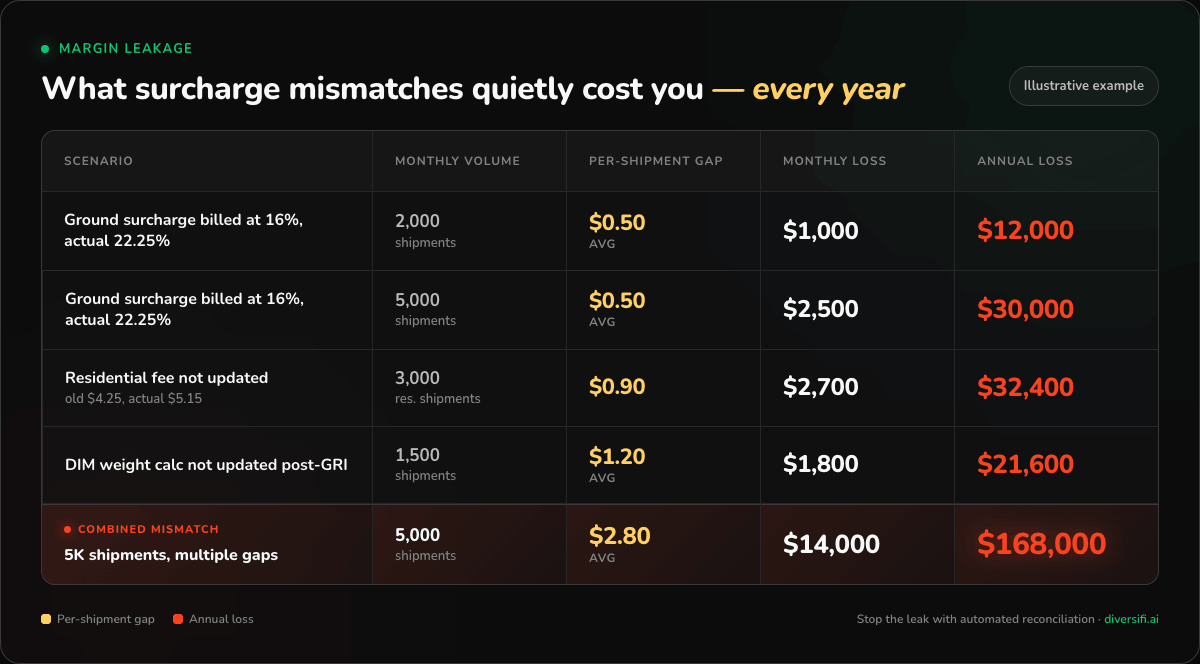
$168,000 per year on a single 5,000-shipment-per-month account. That's not an edge case, that's what happens when multiple small gaps compound across a mid-size client over a calendar year.
And this is just the direct billing impact. It doesn't account for the downstream effects: time spent investigating discrepancies when a client questions an invoice, credits issued to resolve disputes that could have been avoided, and the harder-to-quantify cost of a client who starts auditing every invoice because they've found errors before.
How Connected Billing and Routing Software Closes the Gap
The good news is that this is a solvable problem, not through more manual process, but through connecting the systems that currently operate in isolation.
When carrier routing and billing software share the same data layer, the carrier-to-quote mismatch stops being a slow leak and starts being a visible exception. Here's what that looks like in practice.
Carrier cost updates propagate automatically
When your billing platform is connected to live carrier rate data (rather than relying on someone to manually update a spreadsheet) surcharge changes apply to new quotes and invoices as soon as they take effect. The gap between what UPS is charging and what you're billing closes to zero, because both sides of the equation are drawing from the same source.
This matters especially in the current environment. Fuel surcharges are moving more frequently than they have in years. A platform that requires a manual update cycle to stay current is perpetually running behind. One that pulls from live carrier data is always accurate.
Quote-to-bill consistency becomes structural
When the cost data used to build a bid flows directly into the billing system (rather than being re-entered or approximated by the billing team) the quote and the invoice reflect the same underlying cost structure. There's no translation step where information can drift, get lost, or get approximated.
This means the margin you modeled when you priced the account is the margin you actually capture on it. Not a close approximation. Not a post-hoc calculation based on what you think the cost was. The same data, end to end.
Carrier invoice reconciliation surfaces mismatches before they compound
Beyond the quote-to-bill connection, strong billing software reconciles carrier invoices against shipment records before generating client invoices. When a carrier charges more than expected on a lane, that discrepancy surfaces as an exception for review rather than as a silent cost you absorb.
This is a fundamental shift in how margin protection works. Instead of discovering a gap when someone pulls a margin report six months later, you see it on the carrier invoice within the billing cycle. You can act on it by disputing it, adjusting the client rate, or rerouteingthe volume before the compounding effect takes hold.
Margin visibility turns reactive into proactive
When billing and carrier routing are connected, you also gain something that neither system provides alone: real-time margin visibility by account, by carrier, and by lane. You can see which accounts are running at healthy margins and which are drifting. You can identify the specific lane or surcharge that's causing the problem before it becomes a significant loss.
That visibility changes the nature of the conversation you have with clients at contract renewal. Instead of guessing where costs have moved since the last signature, you have data. Instead of renegotiating reactively because a margin problem finally surfaced, you're having a proactive conversation built on a clear picture of what the account actually costs to service.
What to Do Right Now
If you've read this far and you're not sure whether your current billing process has a carrier-to-quote gap, here's a quick diagnostic. Pull your three largest accounts by volume and check the following:
- When was the client rate card last updated? If it's been more than one quarter, it's probably drifted.
- What fuel surcharge rate is applied in the client billing? Compare it to the current published surcharge for the carrier and service type you're using on that account.
- Has your residential delivery fee been updated since the last carrier GRI? Residential fees have moved more than most operators realize in the past 18 months.
- Is your DIM weight calculation consistent with the carrier's current divisor? GRIs sometimes include DIM weight adjustments that don't get flagged as prominently as base rate changes.
- Is there any account where the margin has declined over the past two quarters without a corresponding change in your cost structure? That's often a quiet indicator of a billing drift problem.
If any of these checks surfaces a discrepancy, the fix isn't complicated but it does need to happen before the gap compounds further. Update the rate card, reconcile the current carrier cost against what's been billed, and evaluate whether the account needs a contract conversation.
The more important question is what prevents this from happening again? That's a systems question, not a process question. More careful manual updating of spreadsheets will reduce the gap temporarily. Connected billing and routing software eliminates it structurally.
How DiversiFi Helps
DiversiFi's AI Dynamic Billing and AI Carrier Routing platforms are designed to work together for exactly this reason. Carrier cost data (including current surcharge schedules) flows from the routing layer into billing automatically, so the rate used to price a shipment is the same rate applied when the invoice is generated. Rate cards are version-controlled and connected to live carrier data, so they don't drift between contract updates. Carrier invoices are reconciled against shipment records before client billing, so discrepancies surface as exceptions rather than as invisible margin erosion.
The result is a billing process where the carrier-to-quote gap closes structurally, not through manual vigilance. Margin that used to disappear quietly now shows up on the bottom line. Where it belongs.
If you want to understand the scope of any current mismatch in your billing before making any decisions, we offer free cost modeling. Most operators are surprised by what a relatively small per-shipment gap compounds to across a year of volume.
The gap is almost always smaller than the anxiety about finding it. And it's always worth knowing.
Frequently asked questions
What is margin leakage in 3PL billing?
How should 3PLs handle unexpected carrier rate increases?
What is 3PL bidding software?
Continue learning


See AI for your 3PL In Action
Discover how our solutions can drive your success.