

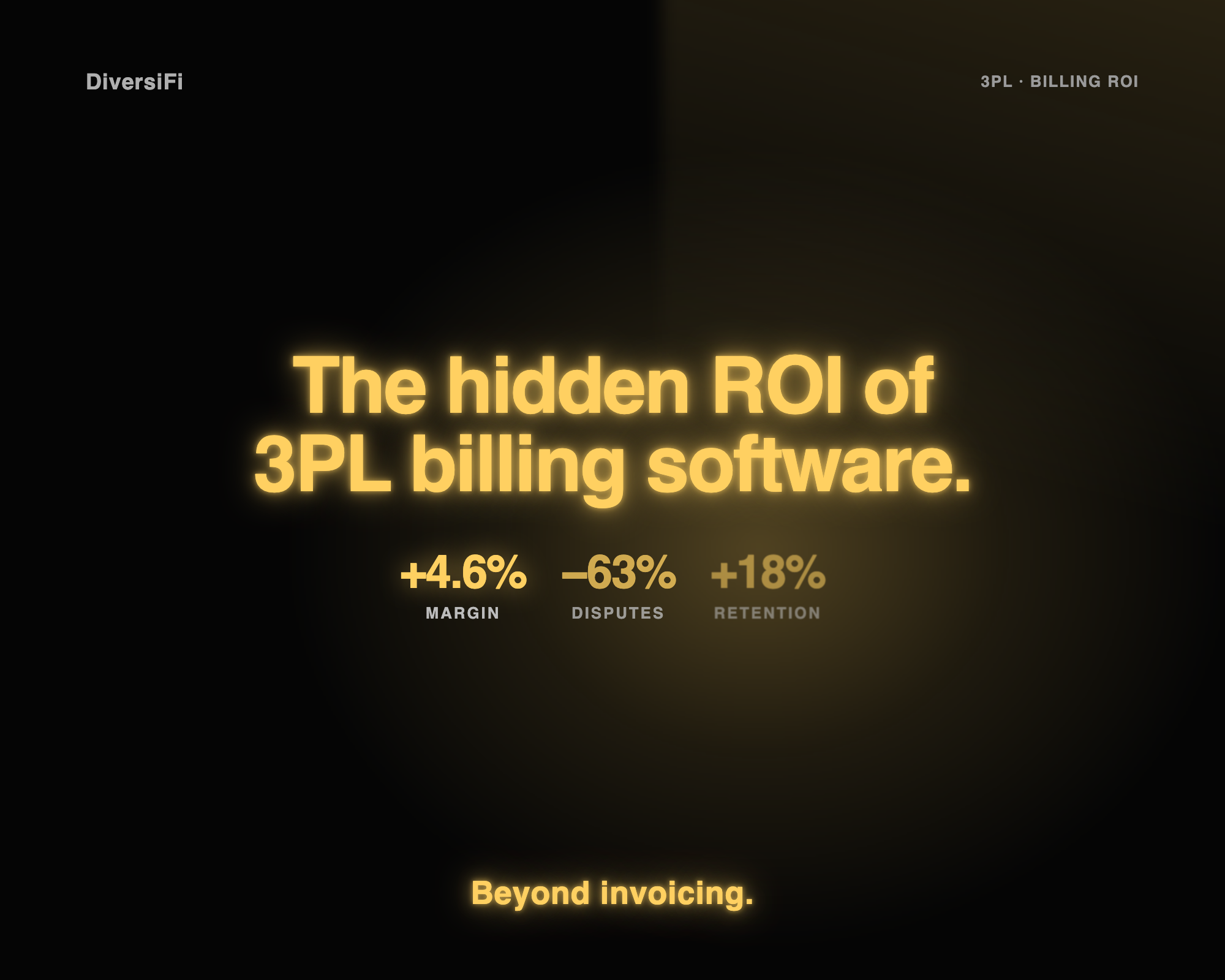
The Hidden ROI of 3PL Billing Software: Beyond Invoicing

Ask a 3PL operator what their billing software is worth and most of them will do some version of the same math. They count the hours saved on invoice generation, estimate the reduction in billing disputes, maybe factor in the surcharges that were getting missed before automation. They come up with a number, compare it to the software cost, and decide whether the investment pencils.
That math is real. But it captures maybe half of what billing software actually returns.
The other half is harder to see on a spreadsheet, because it shows up in places most operators don't think to look. Better bidding decisions. More accurate carrier negotiations. Stronger client retention. Faster responses to market shifts like the carrier surcharge increases that have been rolling through 2026. Smarter conversations at contract renewal time.
This post is about that other half. Because if you are only measuring billing software against the cost of manual invoicing, you are undervaluing the investment by a significant margin.
Start With What Everyone Already Counts
Before getting into the hidden returns, it is worth being clear about the direct ROI that most operators do calculate, because it sets the floor for the total value conversation.
The direct returns from 3PL billing automation are well established at this point. Billing cycles that used to take three or four days compress to same day. Staff time that was going into manual data gathering, surcharge lookups, and invoice assembly gets redirected to higher value work. Missed charges and billing errors drop significantly when rate cards are automated and carrier invoice reconciliation happens before billing goes out the door.
We modeled this in an earlier post: a 3PL processing 5,000 shipments per month with common billing inefficiencies can easily lose $150,000 or more per year in unbilled charges. Fuel surcharges billed at stale rates. Residential fees not updated after a carrier GRI. DIM weight calculations that have not been revisited. These are the numbers that get captured when billing automation is in place.
That is the floor. Now let's talk about what sits above it.
Billing Data as a Bidding Intelligence Tool
One of the most underappreciated returns from billing software is what the data does for your bidding process.
When every shipment is billed through an automated system that tracks carrier costs, applied rate cards, and actual margin at the line item level, you build an extraordinarily rich picture of what it actually costs to service different types of freight. That picture does not just tell you how much you made last month. It tells you how to price the next account.
Think about what this means practically. You are bidding on a new client. They are shipping a mix of residential ground and some air, primarily through a corridor you already run. In a manual environment, you estimate based on your general knowledge of current rates, build in a margin buffer to protect against uncertainty, and submit the quote.
In a world where your billing data is organized and accessible, you can pull your actual cost per shipment on comparable freight over the past 90 days. You know exactly what the fuel surcharge has been running, what residential fees are averaging, what your true margin has been on similar accounts. You price with precision instead of with approximation.
The result is not necessarily a lower price. It is a more defensible one. You can bid more confidently in accounts where your cost structure genuinely gives you an advantage. You can hold your ground in accounts where the economics are tighter than they look. And you stop padding quotes with uncertainty buffers that are making you uncompetitive.
That is a meaningful revenue driver, not just a cost reduction. Winning just one additional account per quarter because your bids are more accurate than your competitors is ROI that never shows up in the billing efficiency calculation.
The Carrier Negotiation Advantage
Here is one that almost nobody talks about, but that operators who have made the transition consistently mention: billing software makes you a better carrier negotiator.
When you walk into a carrier negotiation with detailed, lane level data on your actual shipment volume, service type mix, and cost per move, you are negotiating from a completely different position than someone coming in with a rough estimate of their volume and a general sense of what they are paying.
Carriers know their own data extremely well. They know your volume on their network, your weight profile, your delivery area mix. If you do not know your own numbers as precisely as they know them, you are at a structural disadvantage before the conversation starts.
Billing software that tracks actual carrier costs at the shipment level, organized by lane and service type, closes that asymmetry. You can walk in and say: here is our ground volume by corridor, here is our residential percentage, here is our average DIM factor, here is what we paid in fuel surcharges over the past year. Now let us talk about what rates reflect that profile.
That kind of specificity changes the negotiation. It is harder for a carrier to anchor on a general rate card when you have specific data that tells a different story about your actual cost to serve.
In the current surcharge environment, this matters more than ever. UPS ground is running a 22.25% fuel surcharge. FedEx is at 22.50%. USPS added 8% in April. If you have clean data on what surcharges have actually cost you by carrier and lane over the past 12 months, you have something concrete to bring to those conversations.
Client Retention Through Billing Clarity
The ROI calculation on client retention is one that operators tend to undercount, because the losses show up as client churn rather than as billing line items.
Here is the dynamic that plays out when billing is opaque or inconsistent. A client receives an invoice with a line item they do not recognize or cannot reconcile with their own records. They email their account manager. The account manager has to dig into the billing system, track down the originating shipment, confirm the charge was correct, and send an explanation. That exchange takes hours of labor on your side and introduces friction on theirs.
If it happens once, it is a minor irritant. If it happens repeatedly, it erodes trust in a way that is very hard to rebuild. Clients who do not trust their invoices start auditing everything. They become high maintenance accounts. And eventually, many of them start looking for a 3PL whose billing they can actually rely on.
The cost of losing a client to billing disputes is not just the lost revenue from that account. It is the cost of replacing them. Industry averages on customer acquisition cost in logistics vary widely by segment, but for a mid size 3PL adding a client that generates $200,000 per year in revenue, the combined cost of sales time, onboarding, and ramp can easily reach $15,000 to $20,000. Losing two accounts per year to billing friction, at that replacement cost, is a $30,000 to $40,000 problem that never shows up in anyone's billing ROI calculation.
Billing software that generates transparent, line item invoices that clients can audit themselves changes this dynamic entirely. When a client can see exactly what they are being charged and why, and when the answer to every question is traceable back to a specific shipment and a specific rate, the trust component of the relationship gets resolved once and stays resolved.
Speed as a Competitive Signal
There is a version of billing ROI that is about internal efficiency, and there is a version that is about external perception. The external version is underrated.
When your billing cycle is fast, accurate, and consistent, it signals something to your clients about how your operation runs overall. Clients do not think of billing as separate from operations. They think of it as evidence of operational capability. A 3PL that gets invoices right, on time, every cycle is a 3PL that has its processes under control.
The inverse is also true. A 3PL that sends late invoices, issues frequent credits, or takes a week to answer billing questions is communicating something about their operational maturity whether they intend to or not.
In competitive renewal conversations, billing quality comes up more often than most operators expect. A client who has had clean billing for two years is much less likely to entertain a pitch from a competitor. A client who has been managing billing exceptions every month is already halfway out the door before the competitor calls.
A Better Picture of Which Clients to Keep
This one requires honesty, but it is one of the most valuable things billing software gives you: a clear view of which accounts are actually worth keeping.
Not all revenue is good revenue. A client generating $300,000 per year in billing but running on a margin structure that has drifted over 18 months of carrier rate increases might actually be generating very little profit after carrier costs are accounted for. Without the data, you know the revenue number but not the true margin. You might be working hard to retain an account that is costing you money.
Billing software that tracks margin at the account level, not just revenue, gives you a fundamentally different view of your business. It lets you have honest conversations about which clients to invest in growing, which ones to reprice at renewal, and which ones to let go if the economics do not work.
That kind of portfolio visibility is not just a billing benefit. It is a strategic capability. Operators who know their true margin by account make better decisions about where to invest in capacity, where to focus sales effort, and where the business is actually generating returns.
What this looks like in practice
Consider two accounts on paper generating similar revenue. Account A runs lean residential ground freight on a well negotiated carrier lane. Account B involves a high proportion of air freight, significant residential surcharge exposure, and a rate card that has not been updated since the last GRI.
In a manual billing environment, both accounts look similar on the revenue line. In a billing platform with margin visibility, Account A is a high quality account worth investing in. Account B has a margin problem that needs to be addressed before the next renewal.
The difference is not in the clients. It is in whether you can see it.
The Compounding Effect Over Time
All of the ROI categories above are more valuable the longer billing software has been in place, because the data compounds.
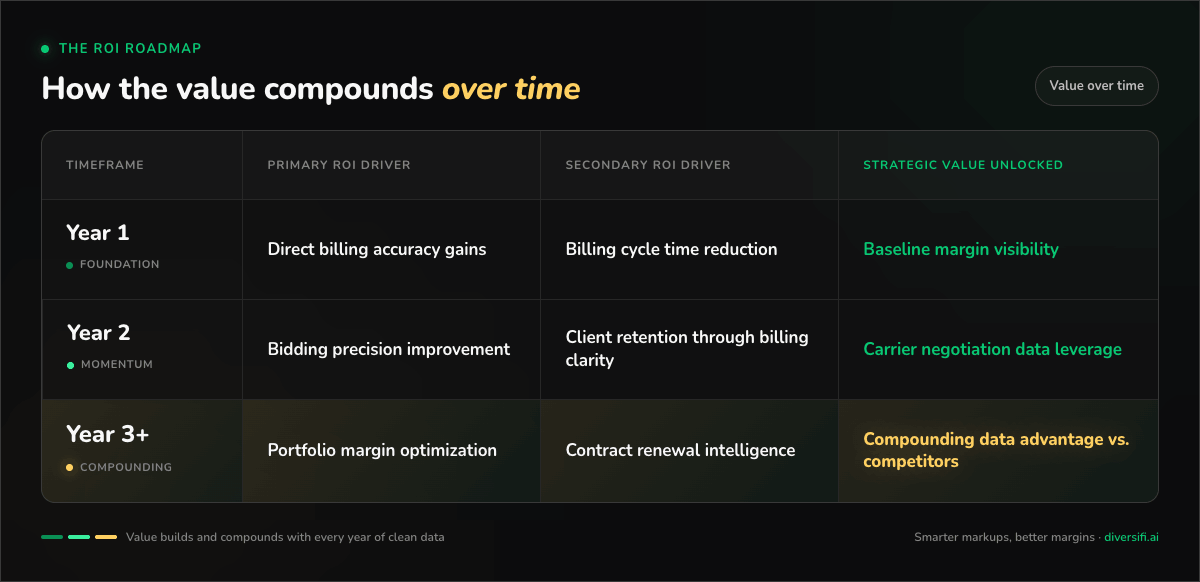
In year one, you are capturing the direct billing efficiency gains and starting to build the data set that improves bidding accuracy. In year two, you have enough historical data to negotiate carrier contracts with genuine leverage. In year three, you have a multi year picture of account level margin that makes renewal conversations significantly more informed than anything a competitor can bring to the table.
This is why the one year ROI calculation undersells the investment. The returns from billing software are not static. They grow as the data repository deepens, as the rules engine becomes more refined, and as the operational decisions it informs get better and better.
How DiversiFi Delivers the Full Return
DiversiFi built AI Dynamic Billing to deliver the full stack of ROI, not just the invoice accuracy layer. The platform captures every charge, every surcharge, and every carrier cost at the shipment level and organizes that data into a reporting layer that feeds better bidding through Bid Boost and better carrier decisions through AI Carrier Routing.
The three products are designed to work together because the value of each one compounds when they share the same data foundation. Billing data informs bidding. Bidding outcomes feed back into billing benchmarks. Carrier routing decisions are validated against actual margin data. The whole system gets smarter over time in a way that none of the three products delivers on its own.
If you want to understand the full ROI picture for your specific operation before making any decisions, we can model it out. Not just the invoice accuracy gains, but the bidding impact, the carrier negotiation leverage, and the client retention value based on your actual volume and account mix.
The number is almost always larger than operators expect. And it grows every year the platform is in place.
Frequently asked questions
What is AI carrier routing and how does it work for 3PLs?
What is 3PL bidding software?
What is dynamic billing in logistics?
Continue learning



See AI for your 3PL In Action
Discover how our solutions can drive your success.