

74% of Shippers Would Switch 3PLs Over AI. Here Is What That Means for Your Business.

There is a question showing up more and more in 3PL sales conversations and client reviews. It does not always get asked directly. Sometimes it comes wrapped in a question about technology or visibility or how you handle billing. But the underlying question is the same.
Are you using AI? And if so, how?
This is not a future trend. It is happening right now in RFPs, in renewal conversations, and in the quiet decisions your current clients make about whether to stay or start looking elsewhere. And the data behind it is more decisive than most 3PL operators realize.
The Number That Should Get Your Attention
Read that again, because it is worth sitting with for a moment.
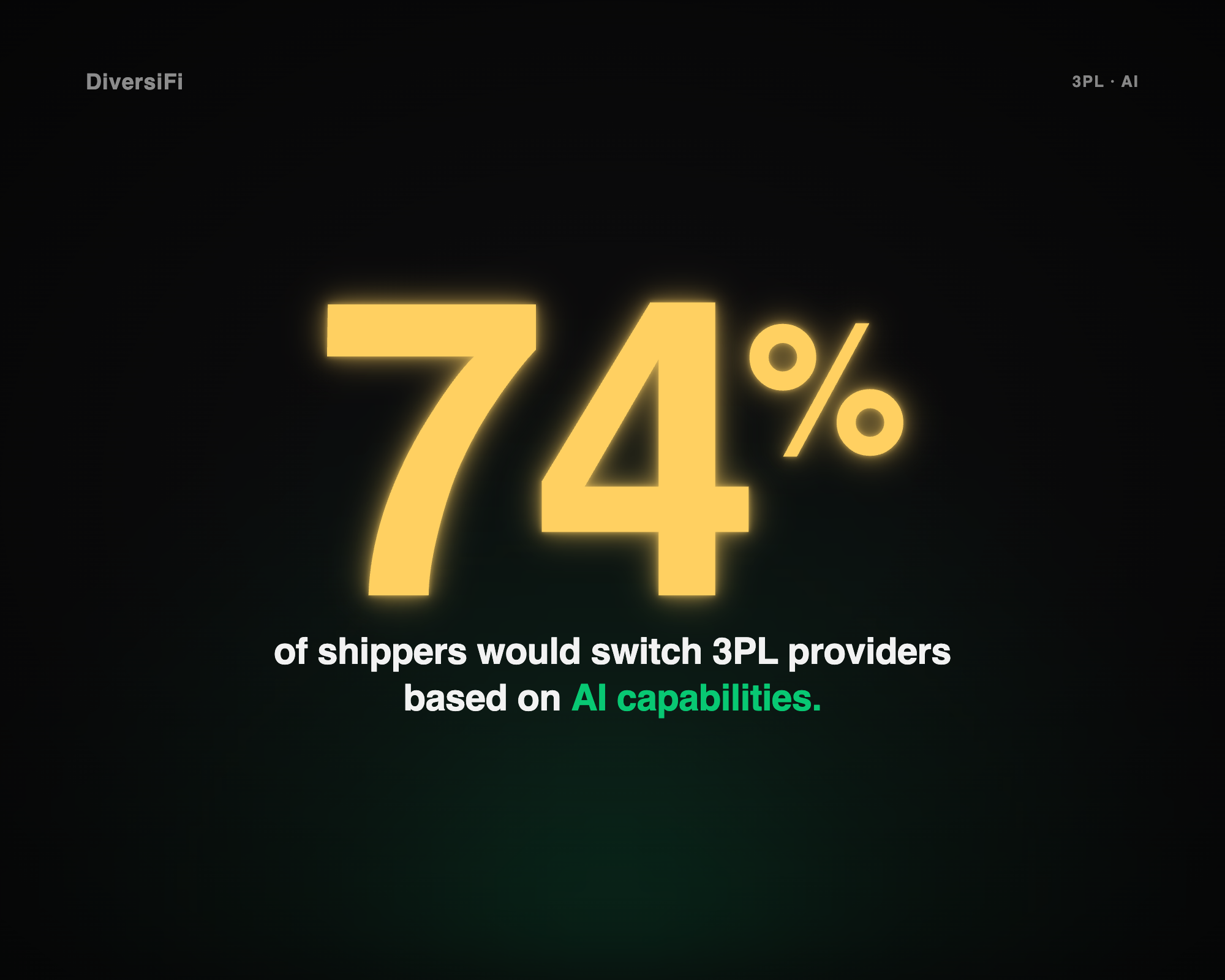
Three out of four shippers are willing to move their business to a different 3PL if that provider has better AI tools. That is not a niche preference from a handful of tech forward brands. That is a majority position across the shipper landscape, and it reflects a fundamental shift in how clients evaluate their logistics partners.
The same study found that AI is now considered the most impactful logistics technology by 94% of respondents, up 10 percentage points in just two years. For context, driverless vehicles ranked second at 46%. The gap between AI and everything else is enormous, and it is growing.
What this means for 3PLs is simple but significant. AI capability is no longer a differentiator that helps you win deals at the margin. It is becoming a baseline expectation. The 3PLs that do not have a clear, credible answer to the AI question are not just losing deals. They are already at risk of losing clients they think are secure.
What Clients Are Actually Asking About
When shippers say they would switch providers based on AI capabilities, they are not necessarily imagining robots in your warehouse or a fully autonomous operation. The specific AI applications that matter most to 3PL clients tend to be operational, financial, and transactional.
They want to know whether your billing is accurate and automated. They want to know whether you can give them real time visibility into costs without a manual report pull. They want to know whether your quoting process is backed by data or by approximation. They want to know whether your carrier decisions are optimized or just habitual.
These are questions about whether your operation is running on intelligence or on effort. And increasingly, the clients willing to pay a fair margin for quality service are choosing providers who can answer confidently.
The question behind the question
When a shipper asks about your AI capabilities, they are really asking something more specific.
Can I trust that your invoices reflect what actually happened? Can your team respond to market changes quickly, or do you find out about problems after I do? When you quote me a rate, is it based on real data or on a best guess padded with a safety buffer?
AI is the technology that makes those questions answerable with confidence. The 3PLs investing in it are not just buying software. They are buying the ability to say yes.
Why Most 3PLs Are Behind on This and What to Do About It
The honest reality is that most mid size 3PLs are behind on AI adoption, and for understandable reasons. The technology landscape is noisy. There are a lot of vendors claiming AI capabilities that are really just better spreadsheets with a modern interface. Integration feels complex and expensive. And the day to day demands of running an operation do not leave much bandwidth for technology evaluation.
But here is what is happening while that evaluation gets deferred. The 3PLs that made the investment 12 to 18 months ago are now showing up to RFPs with answers that others cannot match. They are retaining clients at higher rates because their billing is cleaner and their reporting is faster. They are winning new accounts that might have gone to a competitor on price, because their technology story changed the evaluation criteria.
The gap is widening. And the cost of getting started is lower than most operators think, particularly when you work with a partner who has already built the integrations.
How to Actually Integrate AI Into Your Operation Without Starting From Scratch
The biggest misconception about AI integration is that it requires a complete technology overhaul. It does not. The most effective approach for most 3PLs is targeted deployment in the areas where AI delivers the clearest and fastest return, connected to the systems already in place.
There are three areas where AI integration pays off fastest for 3PL operations.
Billing and Invoice Automation
This is the highest ROI starting point for most 3PLs, and the one with the most direct connection to both cost reduction and client trust. AI billing tools match carrier invoices against shipment records automatically, apply the correct rate card without manual lookup, capture surcharges in real time, and flag exceptions for review before invoices go out.
The result is billing that is faster, more accurate, and fully auditable. Clients stop disputing invoices because the invoices are right. Billing staff stop spending half their week on data gathering and reconciliation. And the margin that was quietly leaking through missed surcharges and stale rate cards starts showing up where it belongs.
For a 3PL processing 5,000 shipments per month, the direct billing accuracy gains alone can represent $150,000 or more per year in recovered margin. That is a return that funds a significant portion of the technology investment before you account for any of the secondary benefits.
Carrier Routing and Cost Optimization
AI carrier routing replaces static routing guides with a system that evaluates the real cost and performance profile of each carrier for each shipment in real time. It accounts for current surcharge levels, lane performance history, and delivery time requirements before making a routing decision.
In the current carrier environment, where fuel surcharges have risen sharply across UPS, FedEx, USPS, and Amazon through 2025 and 2026, the ability to route dynamically based on actual current costs rather than last quarter's guide is a meaningful margin lever. A 3PL that can show a client that their shipments are being routed to the most cost effective carrier for each move, with the data to back it up, is having a very different conversation than one that is running on a routing guide that gets reviewed once a year.
Bidding and Pricing Intelligence
AI bidding tools turn your historical billing and carrier cost data into a competitive advantage in new business conversations. Instead of building a quote on estimated rates and uncertainty buffers, you pull from actual cost data on comparable freight, apply current surcharge levels automatically, and see your margin before you submit.
The 3PLs winning more new business right now are not always the ones with the lowest rates. They are often the ones who respond fastest with the most precise, credible proposals. AI bidding tools make that possible at a scale that manual processes cannot match.
The Integration Reality: It Is Simpler Than You Think With the Right Partner
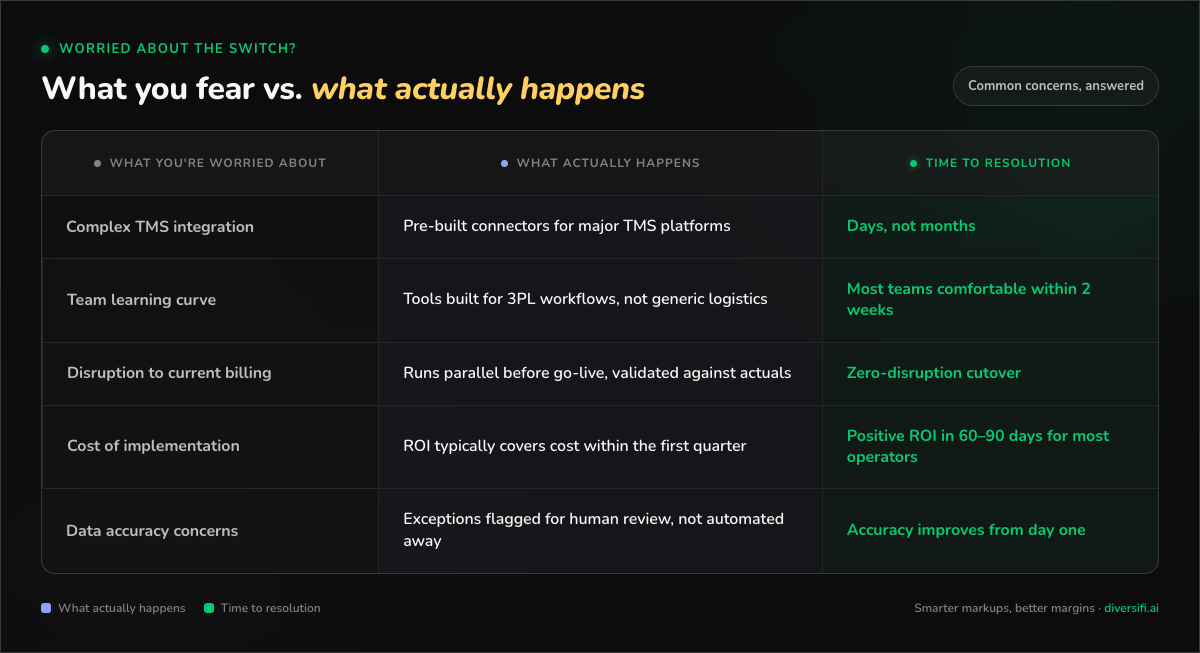
The reason most 3PLs have not moved faster on AI is not that the technology is too complex. It is that integration feels overwhelming when you are evaluating it alone. Connecting a new billing platform to your TMS, making sure your carrier data flows correctly, training your team on a new workflow, managing the transition without disrupting current operations, these are real concerns.
The right technology partner removes most of that friction. DiversiFi's AI Dynamic Billing, Bid Boost, and AI Carrier Routing are built to connect to the systems you already use, not to replace them wholesale. The integrations are pre built for the most common TMS platforms. The onboarding is structured around your existing workflow, not a generic implementation template. And the learning curve is significantly shorter than most operators expect because the tools are designed for 3PL operations specifically, not adapted from a generic logistics platform.
The time to value is measured in weeks, not quarters. And the returns compound from the moment the system goes live.
How AI Capabilities Win New Clients
Beyond the operational returns, there is a business development story here that is worth telling explicitly.
When you walk into an RFP response or a first meeting with a prospective client and you can describe your AI capabilities specifically, not generically, the conversation changes. You are not talking about software features. You are talking about outcomes.
Your billing is automated and auditable, so they will never have to wonder whether an invoice is right. Your carrier routing is optimized in real time, so their freight is always moving on the most cost effective option available. Your quoting process is backed by real data, so the rate you put in front of them reflects your actual cost structure, not an estimate padded with uncertainty.
That story answers the question 74% of shippers are already asking. And it answers it before they have to ask.
The 3PLs winning new accounts right now on AI capability are not necessarily larger or better resourced than their competitors. They invested earlier in the right tools and they learned to tell the story clearly. Both of those things are achievable for any operator who is ready to move.
How AI Capabilities Retain the Clients You Already Have
The retention side of this is just as important as the acquisition side, and it is the one that operators tend to underestimate.
Your current clients are being approached by competitors. Some of those competitors have invested in AI tools and are showing up to those conversations with a technology story you may not have yet. Clients who are satisfied but not particularly loyal, the ones who stay because switching feels like a hassle, not because they are genuinely committed to your partnership, are the most vulnerable.
The best insurance against that vulnerability is making yourself indispensable through capability. When a client's billing questions get answered instantly through an auditable system rather than a manual investigation. When their carrier costs are visibly optimized rather than opaque. When renewal conversations are grounded in data about what the account actually looks like, not in a general sense of how it has been going.
Those clients do not switch. Not because switching is hard, but because the cost of giving up that capability is real and visible.
Where to Start
If you are reading this and recognizing that your AI story is not where it needs to be, the starting point is simpler than it probably feels right now.
Start with billing. It is the area with the clearest ROI, the fastest time to value, and the most direct connection to both client trust and competitive positioning. A client who gets accurate, automated, auditable invoices from you every billing cycle has a very specific, positive AI experience with your operation, even if they never think of it that way.
From billing, extend into routing and then bidding. Each layer compounds the data advantage and adds another chapter to the AI story you can tell in client and prospect conversations.
You do not have to build this from scratch or figure it out alone. DiversiFi offers free cost modeling that shows exactly where your current operation is leaving margin on the table and where AI automation would close those gaps first. Most operators are surprised by both the scope of the opportunity and how quickly it can be captured.
Your clients are already asking the question. The sooner you have a good answer, the better the conversation goes.
Frequently asked questions
What is AI carrier routing and how does it work for 3PLs?
How is AI being used in 3PL operations?
How does AI dynamic billing work?
Continue learning

See AI for your 3PL In Action
Discover how our solutions can drive your success.