


How to Automate 3PL Billing in 2026: The Complete Guide

If you have been running freight billing manually, you already know the signs. A billing cycle that stretches three or four days. Surcharge rates that are always slightly behind what the carriers are actually charging. An invoice dispute that takes two hours to resolve and ends in a credit for a charge that was technically correct. A margin report that does not match what you expected when you priced the account.
In 2026, with carrier surcharges at multi-year highs, Amazon competing openly in logistics, and shippers evaluating 3PLs on their technology capabilities, manual billing is not just inefficient. It is a competitive liability.
This guide walks through exactly how manual freight billing breaks down, what automated 3PL billing software actually does, and how to implement it in a way that protects your margins and reduces errors from the first billing cycle.
Part 1: Why Manual Freight Billing Breaks Down
Understanding where manual billing fails is the starting point for understanding what automation fixes. Most 3PL operators who have run billing manually for any length of time can identify the symptoms. Fewer have mapped the root causes clearly enough to know where the fix needs to happen.
The Rate Card Problem
Rate cards are supposed to be the authoritative source of truth for what you charge each client, for each service, under each set of conditions. In a manual environment, they live in spreadsheets or TMS configuration files that get updated inconsistently. Someone on the billing team knows that UPS raised their ground fuel surcharge last quarter, but the rate card still reflects the old number because updating it means cross-referencing the new UPS schedule, recalculating the markup, and touching a shared file that nobody wants to get wrong.
The result is billing that is systematically off. Not dramatically, but consistently. Over thousands of shipments per month, that consistency compounds into significant annual margin leakage.
The current surcharge environment makes this worse than it has ever been. UPS ground is running a 22.25% fuel surcharge. FedEx is at 22.50%. USPS added 8% in April 2026, the first fuel surcharge in their history. A rate card that has not been updated since Q4 2024 is billing clients at rates that no longer reflect reality on every surcharge-affected shipment.
The Carrier Invoice Matching Problem
In most manual billing workflows, client invoices are generated before carrier invoices have been fully reconciled. The billing team works from shipment data and their best understanding of what the carrier will charge, not from the actual carrier invoice. When the carrier invoice arrives and does not match, the discrepancy is either absorbed quietly or triggers a time-consuming investigation.
This means client invoices are regularly built on estimates rather than actuals. When those estimates are wrong in your favor, you either absorb the difference or issue a correction. When they are wrong in the client's favor, you have overbilled and created the conditions for a dispute.
Neither outcome is acceptable, and both are built into the manual process by design.
The Data Entry Problem
Every manual step in a billing workflow is a place where information can be entered incorrectly, transposed, omitted, or applied to the wrong shipment. DIM weight calculations that use the wrong divisor. Accessorial charges applied to the wrong service type. Residential flags missed because they came in on a lane that does not usually see residential delivery. Address correction fees that never made it off the carrier portal and onto the client invoice.
These errors are not caused by careless people. They are caused by a process that requires humans to make accurate decisions across dozens or hundreds of variables per billing cycle, consistently, under time pressure, every period without exception. No process built that way stays accurate at scale.
The Volume Scaling Problem
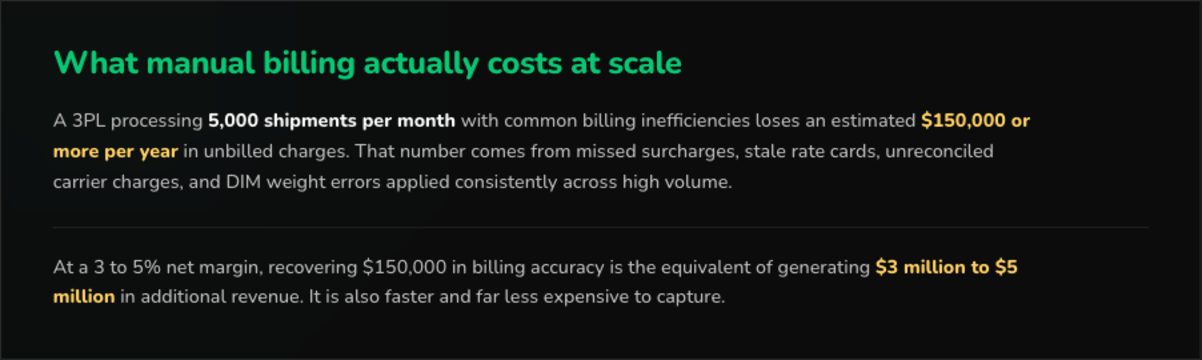
Manual billing processes that work adequately at 1,000 shipments per month start showing cracks at 3,000 and break down visibly at 5,000 and above. The billing team grows to keep up, which increases labor costs and creates more surface area for inconsistency. Billing cycles get longer. Errors increase in proportion to volume. And the margin impact of each error grows as the business gets larger.
For a 3PL with ambitions to grow, manual billing is not just an operational constraint. It is a ceiling.
What manual billing actually costs at scale
Part 2: What Automated 3PL Billing Software Actually Does
The term billing automation gets used loosely. Before evaluating any platform, it is worth being specific about what genuine billing automation actually does, because not all tools that call themselves automated are doing the same work.
Automated Rate Card Management
True rate card automation means rate cards are stored as version-controlled records inside the billing platform, not in spreadsheets or TMS configuration files that require manual updates. When a carrier contract changes, when a surcharge schedule updates, or when a client agreement gets renegotiated, the change is made in one place and applies to every shipment from that point forward, automatically.
Version control matters as much as the automation itself. When a client questions a charge from two months ago, you can pull the exact rate card version that was in effect on the date of that shipment and show them precisely how the charge was calculated. That audit trail eliminates an entire category of dispute.
Real-Time Surcharge Capture
Automated billing platforms maintain current surcharge schedules for every carrier in your network and apply them at the shipment level based on validated service characteristics. Fuel surcharges, residential delivery fees, dimensional weight adjustments, delivery area surcharges, address correction charges, extended area fees — all of it captured automatically, without a human checking a carrier portal.
In an environment where surcharge rates are moving quarterly and sometimes mid-quarter, this is not a convenience feature. It is the difference between billing what you are actually owed and absorbing costs on every affected shipment.
Carrier Invoice Reconciliation Before Billing
The most significant structural change automated billing makes to your workflow is moving carrier reconciliation before client billing rather than after. Instead of generating client invoices based on estimated charges and reconciling later, the system matches carrier invoices against shipment records first. Discrepancies surface as exceptions for human review. Only validated actuals go onto the client invoice.
This eliminates the category of billing dispute that comes from a client being invoiced for an amount that does not match what you actually paid. It also means the exceptions your billing team spends time on are real discrepancies worth investigating, not routine reconciliation work that should never have required human attention.
TMS Integration Without Manual Data Transfer
Billing software that requires your team to export data from the TMS and import it into the billing platform is not automating your process. It is moving the manual step without eliminating it. Genuine TMS integration means shipment data flows from your TMS into the billing workflow automatically, in real time or near real time, without anyone serving as the data transfer layer.
When a shipment closes in your TMS, the billing data flows downstream. When the carrier invoice arrives and matches, the client invoice is generated from the validated output. The human involvement in routine billing shifts from data handling to exception review, which is where it should be.
Dynamic Pricing Rules Engine
Every 3PL has pricing logic that does not fit a standard template. Per-shipment minimums. Tiered rates that kick in at volume thresholds. Client-specific accessorial agreements. Markup structures that vary by service type. Special handling fees for specific SKU categories.
A dynamic pricing rules engine encodes all of that complexity and applies it consistently to every shipment, without requiring a human to remember every exception. The system handles your most complex client contract the same way it handles your simplest one, and does it without errors.
Part 3: How to Implement 3PL Billing Automation
The biggest barrier most 3PL operators face on billing automation is not the technology. It is the transition. How do you move from a manual process that the team knows and relies on to an automated one without disrupting current operations or introducing new errors during the cutover?
The answer is a phased approach that validates at every step before moving forward.
1. Audit your current process before you change anything
Before implementing any new system, map your existing billing workflow in detail. Where does data come from? Who touches it? Where do errors most commonly occur? Which clients have the most complex rate structures? Which carriers generate the most reconciliation issues? This audit is not just useful for the implementation. It will also show you where your biggest margin leakage is happening right now, which gives you a clear before-and-after benchmark when the automated system goes live.
2. Migrate rate cards into the automated system and validate them
The first substantive step in any billing automation implementation is getting your rate cards into the new platform and verifying that they are accurate. Run the automated rate calculations against your last two or three billing cycles manually and compare outputs. Any discrepancies at this stage are almost always rate card configuration issues rather than platform problems, and they are far better to find here than after go-live. Do not move to the next phase until rate card output matches your manual calculations on at least 95% of shipments.
3. Run parallel billing for two to four weeks
Once rate cards are validated, run the automated system in parallel with your manual process for two to four weeks. Generate invoices both ways and compare them side by side. The differences you find will fall into two categories: errors you were making manually that the automated system corrects, and configuration issues in the automated system that need to be resolved. Both are valuable to know before you switch over fully.
4. Activate TMS integration and carrier reconciliation workflows
With rate cards validated and parallel billing confirming accuracy, activate the TMS integration so shipment data flows automatically rather than through manual export and import. Set up carrier invoice reconciliation workflows so exceptions surface for review rather than requiring end-to-end manual matching. Train the billing team on the exception review process, which should now be the primary focus of their time rather than data gathering and assembly.
5. Cut over and measure from the first billing cycle
Go live fully and measure billing cycle time, error rate, and dispute volume from the first cycle. Most operators see immediate improvement on all three metrics. The most important thing to track in the first 90 days is exception volume, because the pattern of exceptions will tell you exactly where any remaining configuration issues are and where your carriers are most likely to generate invoice discrepancies worth disputing.
Part 4: The Operational Changes Automation Enables
Billing automation is not just a more efficient way to do the same thing. It changes what your billing operation is capable of doing at all.
Faster Billing Cycles
A billing cycle that currently takes three or four days because it requires manual data gathering, rate lookups, surcharge calculations, and carrier reconciliation can compress to same day or next day when those steps are automated. For clients who receive invoices on a schedule tied to your billing cycle, faster cycles mean faster payment. For your cash flow, the difference compounds across every period.
Margin Visibility You Do Not Currently Have
When billing is automated and connected to carrier cost data, you gain margin visibility at the account level, the carrier level, and the lane level that is not practically achievable through manual reporting. You can see which accounts are running at healthy margins and which are drifting. You can identify the specific surcharge or carrier that is causing a margin problem before it compounds into a significant loss.
That visibility feeds better decisions across the business. Better bidding on new accounts. Better carrier negotiations at contract time. Better conversations with clients at renewal. None of those decisions are as informed without accurate, organized billing data behind them.
Client Transparency as a Competitive Tool
Automated billing systems generate invoices that tell the full story at the line-item level. Service type. Weight. Applied rate. Surcharge breakdown. Accessorials. When a client can audit their own invoice without calling you, billing stops being a source of friction and becomes a source of trust.
Combined with a client portal that gives brands direct access to their operational data and billing history, this transparency is a retention tool that most 3PLs underutilize. Clients who understand exactly what they are being charged and why do not dispute invoices. They stay.
Part 5: What to Look for in 3PL Billing Software
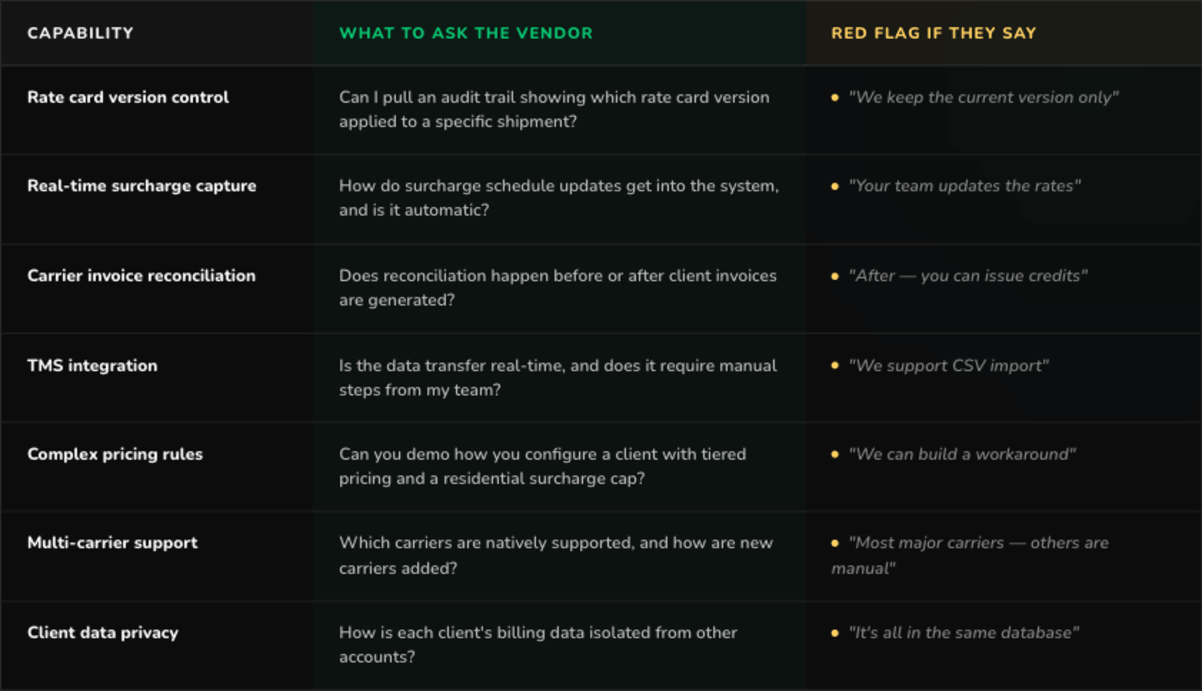
Not all billing platforms are built for the complexity of 3PL operations. Generic invoicing software and basic TMS billing modules handle simple rate-times-weight calculations. They do not handle complex pricing rules, multi-carrier surcharge schedules, carrier invoice reconciliation, or the kind of client-specific rate logic that most 3PLs manage across their account base.
When evaluating platforms, these are the capabilities that separate genuine 3PL billing software from tools that will require manual workarounds within the first quarter of use.
The Right Time to Make the Move
Most 3PL operators who have been through a billing automation implementation say the same thing when asked when they wish they had done it: earlier.
Not because the transition was painful, but because the returns started immediately and they had been leaving money on the table for every month they ran manually before that. The direct billing accuracy gains alone, the missed surcharges and stale rate cards that stop getting absorbed, typically cover the cost of the platform within the first quarter. Everything after that is margin that was always yours but never showing up on the invoice.
If you are currently processing more than 1,000 shipments per month through a manual billing process, the economics of automation almost certainly favor moving now rather than later. The current carrier surcharge environment makes the urgency higher than it has been in years.
DiversiFi's AI Dynamic Billing platform is built specifically for 3PL operations at this complexity level. It handles rate card management, real-time surcharge capture, carrier invoice reconciliation, TMS integration, and complex pricing rules in a single connected system. And because it is part of a broader platform that includes AI Carrier Routing, Bid Boost, the Client Portal, and Embedded Lending, the billing data it generates feeds better decisions across your entire operation.
If you want to understand what billing automation would return for your specific operation before making any decision, we offer free cost modeling. We map your current billing process against what an automated system would deliver and show you where the margin is going right now.
The numbers are usually clearer than operators expect. And the path forward is shorter than it looks.
Frequently asked questions
What is 3PL software?
How does AI dynamic billing work?
What is dynamic billing in logistics?
Continue learning


See AI for your 3PL In Action
Discover how our solutions can drive your success.