


Your Own AI Billing Tools? Here Is What That Actually Costs a 3PL

We've been hearing something similar to this in conversations lately.
A 3PL company is impressed with what DiversiFi does. They get it. And then they say something like: we have actually been working on building something ourselves with AI. We have a developer who has been experimenting with it.
We always take that seriously. It is a smart instinct. AI tools are more accessible than they have ever been, and the idea that you could build something custom, tailored exactly to your operation, is genuinely appealing.
But the conversation that follows is almost always the same. And we thought it was worth talking about here, because a lot of 3PLs are thinking through this same question right now.
What You Are Actually Taking On When You Build It Yourself
Building an AI tool for 3PL billing or sales is not the same as using an AI tool. The gap between the two is where most DIY projects run into trouble.
A large language model, on its own, does not know anything about your carrier contracts. It does not know what a residential surcharge is worth this week on a UPS ground shipment. It does not know the difference between how DIM weight gets calculated on a FedEx lane versus a regional carrier. It has no access to the real-time market data that makes rate recommendations accurate rather than approximate. AI tools and models are only as good as the data you provide them.
What you get when you start building is a general-purpose AI that you then have to teach everything it needs to know to actually be useful for 3PL billing. That means:
- Feeding it your carrier contracts and keeping those inputs current every time a GRI or surcharge update comes through
- Building the rate card logic and testing it against real shipment data to confirm it is calculating correctly
- Handling the integration between the AI layer and your TMS so shipment data flows correctly
- Building validation logic so the system does not generate confident-sounding wrong answers on edge cases
- Stress testing it under real billing volume to see where it breaks
- Debugging it when it breaks, which it will
- Maintaining it as your carrier mix changes, your client base grows, and the underlying AI models update
That is not a side project. For a 3PL, that is a technology company embedded inside your logistics company. And it needs to stay staffed, maintained, and current indefinitely.
The Data Problem That Most DIY Builds Never Solve
Here is the part that is hardest to replicate.
DiversiFi has spent two years building and refining our platform with over $24 billion in logistics market data running through it. That data is what makes our rate recommendations, margin analysis, and billing outputs accurate in a way that a general-purpose AI simply cannot match.
When our system tells you what a shipment should cost on a given lane, it is drawing on real market transactions across carriers, geographies, service types, and time periods at a scale that no individual 3PL could assemble. When it flags that a carrier invoice looks off, it is comparing against a benchmark built from that data, not from a calculation based on a contract you uploaded last quarter.
A DIY AI tool trained on your own data alone sees your operation. DiversiFi's platform sees the market and your competition. That difference is not a feature gap you can close by writing better prompts.
DiversiFi's platform was not built in a sprint. It was built over two years of integration works across multiple LLM models to find the right combination for accuracy and speed in billing-specific tasks.
Testing and refinement against real 3PL billing data to eliminate the edge cases that general-purpose AI gets wrong. Months of stress testing under production-level shipment volumes to find and fix the processing failures that only appear at scale. Ongoing bug fixes as carrier formats change, TMS data structures shift, and client rate structures evolve. Building proprietary data infrastructure that no public AI model has access to.
When you build it yourself, you are starting that timeline from zero. And you are running it in parallel with your actual logistics business.
The Hidden Cost of Doing It Yourself
The appeal of building your own AI tools is that it feels like a lower cost option. You have a developer. You have access to AI APIs. The per-token costs are low. How expensive can it really be?
The cost that gets underestimated every time is the ongoing cost of maintaining something that is actually working correctly in a production environment.
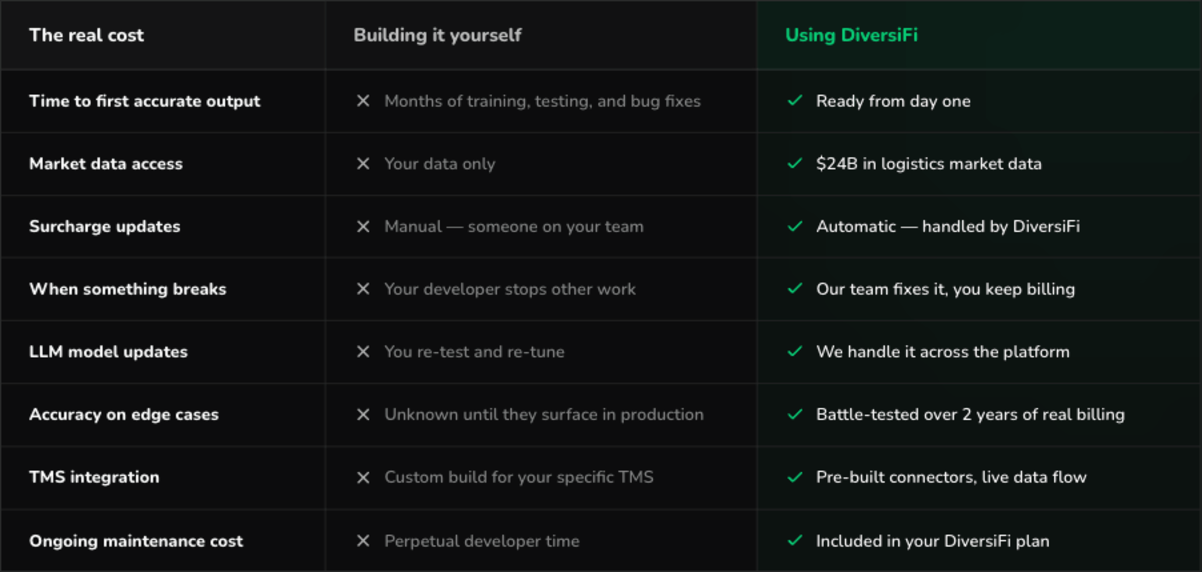
Carrier surcharge schedules change. GRIs roll out. TMS vendors push updates that change data formats. LLM providers update their models, which changes behavior. A rule that worked last month starts producing wrong outputs. A new client has a rate structure the system has never seen before and handles incorrectly. Someone on your team changes a carrier contract and forgets to update the AI's inputs.
Every one of those scenarios requires developer attention to diagnose and fix. In a billing context, where an error does not just produce a wrong answer but produces a wrong invoice that affects real client relationships and real margin, the cost of each failure is not just the developer time. It is the downstream impact on the account.
DiversiFi handles all of that maintenance. When carrier formats change, we update the system. When LLM behavior shifts, we retest and adjust. When edge cases surface in real billing data, our team fixes them across the platform for everyone. You do not spend a single hour on it.
What You Should Actually Be Building
This is not an argument against using AI in your 3PL. It is the opposite.
The 3PLs winning right now are the ones using AI effectively, not the ones building AI infrastructure. Those are two very different activities.
Using AI effectively means having a platform that is already trained, already integrated, already accurate, and already maintained, so you can focus on the decisions that the data enables rather than on keeping the system running. It means spending your time on winning new accounts with better bids, retaining clients with cleaner billing, and having more informed conversations with carriers at contract time.
Building AI infrastructure means spending your time on data pipelines, model tuning, integration debugging, and carrier format updates. Those are not 3PL problems. They are software engineering problems. And they pull your team away from the actual business.
DiversiFi exists specifically so that 3PLs do not have to become technology companies to access the benefits of technology. We spent years building the infrastructure so you do not have to. The market data, the LLM integrations, the carrier reconciliation logic, the stress testing, the bug fixes — all of that is already done.
What you get to do is use it.
You Are Not Just Getting an AI Tool. You Are Getting a Platform That Gets Better Every Week.
Here is something that gets overlooked when operators compare DiversiFi to a DIY AI build: the AI billing capability is one component of what DiversiFi is. It is not the whole thing.
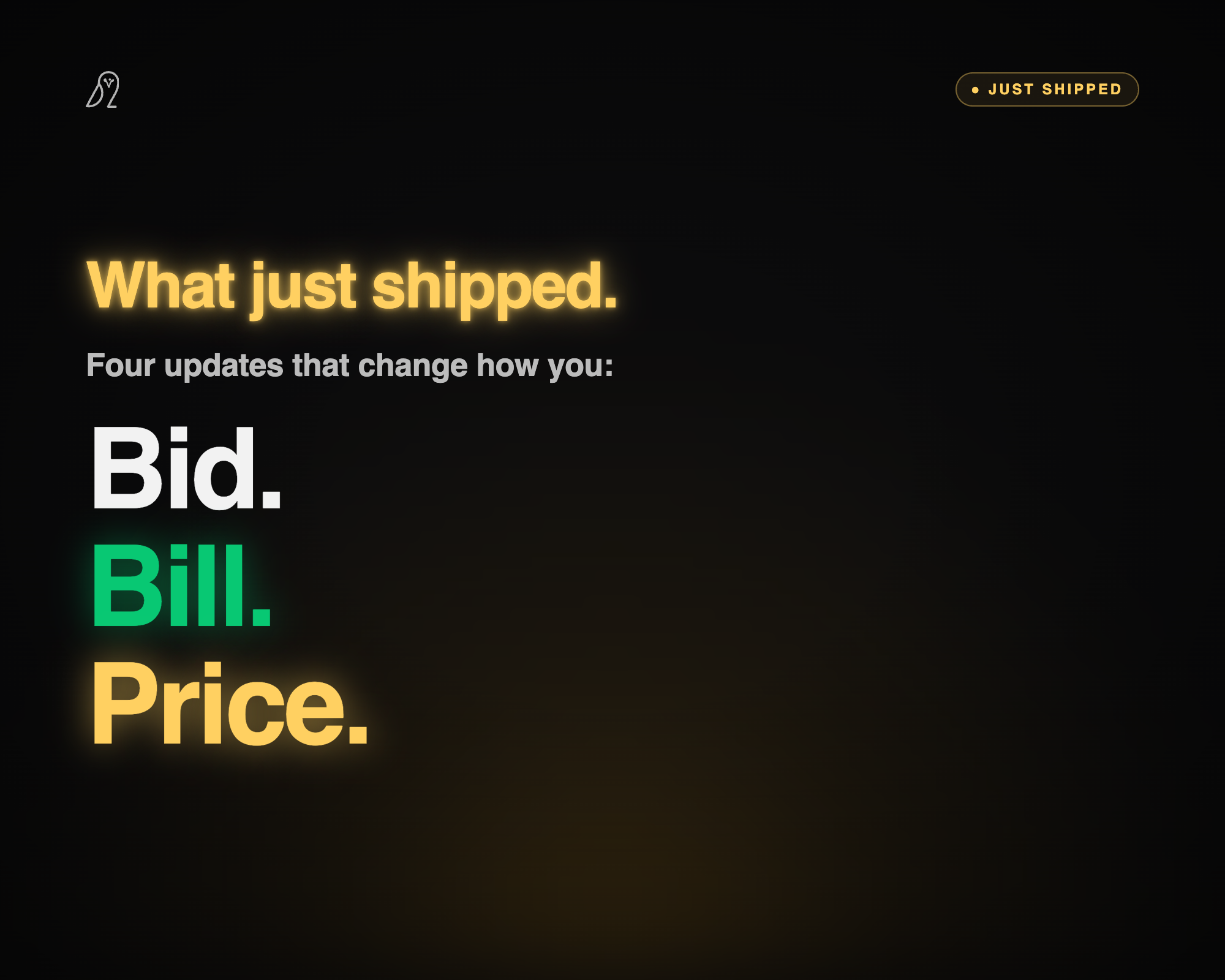
In just the last month, we launched Embedded Lending, the first integrated line of credit built specifically for 3PLs, and a full Client Portal that lets your sales team send interactive branded proposals and gives your clients self-service access to their billing and analytics data. Neither of those is an AI feature. They are operational capabilities that a developer building a billing tool from scratch is not going to be able to include in scope, let alone maintain.
And beyond major launches, the platform updates continuously. Every week, updates ship that most users never have to think about. Storage fee rules. Charge-level markup configurations. UI refinements that make the billing team faster. Integration updates that keep the TMS connection running cleanly as vendors push changes on their end. Rules engine updates as carrier billing formats shift.
That ongoing update cadence is not optional. It is what keeps the platform accurate and useful as the logistics environment changes around it. Surcharge schedules change. Carrier invoice formats change. Client billing requirements evolve. The platform absorbs all of that on your behalf, every week, without anyone at your 3PL spending a single hour on it.
If you are building something yourself, that update cadence is on you. Every carrier format change, every rules update, every new feature your team asks for, every bug that surfaces in production — that is your developer's time, indefinitely. The cost of a DIY build is not a one-time project cost. It is a recurring operational cost that compounds as your business grows and the environment around it continues to change.
DiversiFi gets more valuable and more capable every month. The gap between what the platform does today and what a DIY prototype can do is already significant. That gap widens every time we ship.
If you are in the middle of a build and want an honest conversation about where DiversiFi sits relative to where you are trying to get, we are happy to have it. We can show you what the platform does today, walk through what is shipping in the next few weeks, and let you decide whether the build-it-yourself path is actually the shorter road.
Most operators who have that conversation realize it is not.
Frequently asked questions
What is 3PL bidding software?
How does AI dynamic billing work?
What is dynamic billing in logistics?
Continue learning

See AI for your 3PL In Action
Discover how our solutions can drive your success.